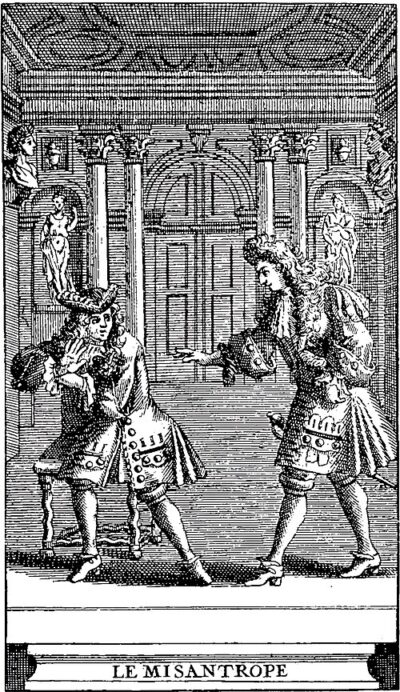
The Misanthrope
The Misanthrope is a comedy by Molière. It came out in 1666.
All 7 facts, and where they come from
Facts
7 facts · 0 confirmed by two sources · 1 cited · 6 from one source
Where this comes from
Papalocal keeps its own record. It started from these sources; what each one said is kept here as it was copied, so a change on their side never changes this page by itself. Tap one to read its version.
What Wikidata says · copied November 17, 2026 · revision 2564208295
- Described as
- comedy by Molière
- Other names
- the Cantankerous Lover
- What it is
- dramatic work
- Written by
- Molière
- Genre
- comedy of manners
- Released
- 1666
- Language
- French · 1 reference
- Country of origin
- France
- Came out
- 1666
- Wikipedias with a page
- 39
Wikidata item Q1053387 (wikidata.org/wiki/Q1053387), public domain (CC0). Copied 2026-11-17.
What Wikipedia says · copied November 17, 2026 · revision 1378585836
The Misanthrope, or the Cantankerous Lover (French: Le Misanthrope ou l'Atrabilaire amoureux; French pronunciation: [lə mizɑ̃tʁɔp u latʁabilɛːʁ amuʁø]) is a 17th-century comedy in verse written by Molière. It was first performed on 4 June 1666 at the Théâtre du Palais-Royal, Paris by the King's Players.
The play satirizes the hypocrisies of French aristocratic society, but it also engages a more serious tone when pointing out the flaws that afflict all humans. The play differs from other farces of the time by employing dynamic characters like Alceste and Célimène as opposed to the flat caricatures of traditional social satire. It also differs from most of Molière's other works by focusing more on character development and nuances than on plot progression. The play, though not a commercial success in its time, survives as Molière's best-known work today.
Because both Tartuffe and Don Juan, two of Molière's previous plays, had already been banned by the French government, Molière may have softened his ideas to make the play more socially acceptable. As a result, there is much ambiguity about whether the main character Alceste is intended as a hero for his uncompromising honesty, or as a quixotic fool. Molière has been the target of much criticism for The Misanthrope over the years. The French philosopher Jean-Jacques Rousseau claimed in his Letter to M. D'Alembert on Spectacles that it was Molière's best work, but hated that it made Alceste the butt of its humour. He believed the audience should support Alceste's high ideals rather than laugh at his misadventures.
From the Wikipedia article “The Misanthrope” (en.wikipedia.org/wiki/The_Misanthrope), by its contributors, under CC BY-SA 4.0 (creativecommons.org/licenses/by-sa/4.0/). Copied 2026-11-17; not changed.
Confirmed Two sources agree. Cited One source, and it names where it got it. One source One source, without a reference of its own. Sources disagree The sources disagree. We show the best-supported value and keep theirs below.
Picture: Unknown artist, via Wikimedia Commons · Public domain