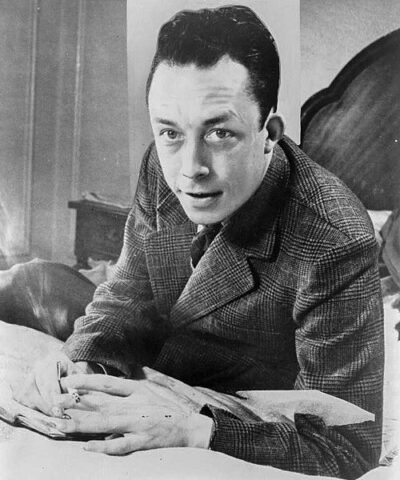
The Myth of Sisyphus
The Myth of Sisyphus is a philosophical essay by Albert Camus. It came out in 1942. It is part of The strange writer.
- Published
- October 1942
- Written by
- Albert Camus
- Genre
- philosophical non-fiction literature
- Country of origin
- France
All 11 facts, and where they come from
Facts
11 facts · 0 confirmed by two sources · 0 cited · 11 from one source
Where this comes from
Papalocal keeps its own record. It started from these sources; what each one said is kept here as it was copied, so a change on their side never changes this page by itself. Tap one to read its version.
What Wikidata says · copied November 17, 2026 · revision 2561268715
- Described as
- philosophical essay by Albert Camus
- Other names
- Le Mythe de Sisyphe
- What it is
- literary work
- Written by
- Albert Camus
- Publisher
- Hamish Hamilton
- Genre
- philosophical non-fiction literature; absurdist literature; essay
- Published
- October 1942
- Language
- French
- Country of origin
- France · 1 reference
- Part of the series
- The strange writer
- Named after
- Sisyphus
- Wikipedias with a page
- 47
Wikidata item Q1125903 (wikidata.org/wiki/Q1125903), public domain (CC0). Copied 2026-11-17.
What Wikipedia says · copied November 17, 2026 · revision 1384797894
The Myth of Sisyphus (French: Le mythe de Sisyphe, pronounced [lə mit də sizif]) is a 1942 philosophical work by Albert Camus. Influenced by philosophers such as Søren Kierkegaard, Arthur Schopenhauer, and Friedrich Nietzsche, Camus introduces his philosophy of the absurd. The absurd lies in the juxtaposition between the fundamental human need to attribute meaning to life and the "unreasonable silence" of the universe in response. Camus claims that the realization of the absurd does not justify suicide, and instead requires "revolt". He then outlines several approaches to the absurd life. In the final chapter, Camus compares the absurdity of man's life with the situation of Sisyphus, a figure of Greek mythology who was condemned to repeat forever the same meaningless task of pushing a boulder up a mountain, only to see it roll down again just as it nears the top. The essay concludes, "The struggle itself towards the heights is enough to fill a man's heart. One must imagine Sisyphus happy."
The work can be seen in relation to other absurdist works by Camus: the novel The Stranger (1942), the plays The Misunderstanding (1942) and Caligula (1944), and especially the essay The Rebel (1951).
From the Wikipedia article “The Myth of Sisyphus” (en.wikipedia.org/wiki/The_Myth_of_Sisyphus), by its contributors, under CC BY-SA 4.0 (creativecommons.org/licenses/by-sa/4.0/). Copied 2026-11-17; not changed.
Confirmed Two sources agree. Cited One source, and it names where it got it. One source One source, without a reference of its own. Sources disagree The sources disagree. We show the best-supported value and keep theirs below.