The Problems of Philosophy
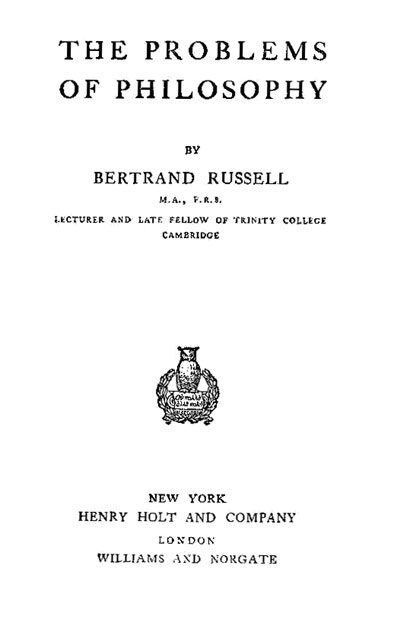
The Problems of Philosophy is a 1912 book by Bertrand Russell. It is part of Home University Library of Modern Knowledge.
- Published
- 1912
- Written by
- Bertrand Russell
- Genre
- philosophy
- Country of origin
- United Kingdom
All 7 facts, and where they come from
Facts
7 facts · 0 confirmed by two sources · 0 cited · 7 from one source
Where this comes from
Papalocal keeps its own record. It started from these sources; what each one said is kept here as it was copied, so a change on their side never changes this page by itself. Tap one to read its version.
What Wikidata says · copied November 17, 2026 · revision 2438983674
- Described as
- 1912 book by Bertrand Russell
- What it is
- written work
- Written by
- Bertrand Russell
- Genre
- philosophy
- Published
- 1912
- Language
- English
- Country of origin
- United Kingdom · 1 reference
- Part of the series
- Home University Library of Modern Knowledge
- Wikipedias with a page
- 20
Wikidata item Q3393210 (wikidata.org/wiki/Q3393210), public domain (CC0). Copied 2026-11-17.
What Wikipedia says · copied November 17, 2026 · revision 1384245699
The Problems of Philosophy is a 1912 book by the philosopher Bertrand Russell, in which the author attempts to create a brief and accessible guide to the problems of philosophy. He introduces philosophy as a repeating series of (failed) attempts to answer the same questions: Can we prove that there is an external world? Can we prove cause and effect? Can we validate any of our generalizations? Can we objectively justify morality? He asserts that philosophy cannot answer any of these questions and that any value of philosophy must lie elsewhere than in offering proofs to these questions.
Focusing on problems he believes will provoke positive and constructive discussion, Russell concentrates on knowledge rather than metaphysics: If it is uncertain that external objects exist, how can we then have knowledge of them but by probability. There is no reason to doubt the existence of external objects simply because of sense data.
The book also looks at the question of mathematical truths and philosophy within mathematics, particularly the question of how pure mathematics is possible.
Russell guides the reader through his famous 1910 distinction between knowledge by acquaintance and knowledge by description and introduces important theories of Plato, Aristotle, René Descartes, David Hume, John Locke, Immanuel Kant, Georg Wilhelm Friedrich Hegel and others to lay the foundation for philosophical inquiry by general readers and scholars alike.In the following pages I have confined myself in the main to those problems of philosophy in regard to which I thought it possible to say something positive and constructive, since merely negative criticism seemed out of place. For this reason, theory of knowledge occupies a larger space than metaphysics in the present volume, and some topics much discussed by philosophers are treated very briefly, if at all.
Russell called the book his 'shilling shocker' and saw it as a short, cheap book, written for a general audience; it has been his most read book for decades. It has often been set as a textbook for philosophy students. However reception of the book among philosophers has not always been positive, for instance, Geoffrey Warnock characterised the book's treatment of perception as having made an "appalling hash" of the topic.
From the Wikipedia article “The Problems of Philosophy” (en.wikipedia.org/wiki/The_Problems_of_Philosophy), by its contributors, under CC BY-SA 4.0 (creativecommons.org/licenses/by-sa/4.0/). Copied 2026-11-17; not changed.
Confirmed Two sources agree. Cited One source, and it names where it got it. One source One source, without a reference of its own. Sources disagree The sources disagree. We show the best-supported value and keep theirs below.
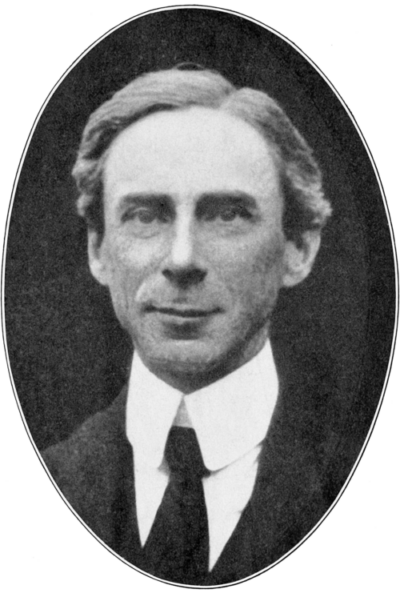
Picture: Bertrand Russell, via Wikimedia Commons · Public domain