
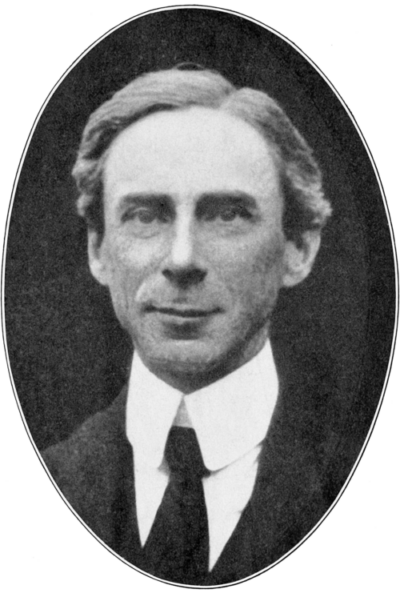
Bertrand Russell
Bertrand Russell was a British philosopher and logician. Born May 18, 1872, in Trellech. Died February 2, 1970, in Penrhyndeudraeth. Positions held include member of the House of Lords (1931–1970). Known for Proposed Roads to Freedom, My Philosophical Development and The Problems of Philosophy. Educated at Trinity College and Frederick William University Berlin. Awards include Nobel Prize in Literature, Fellow of the Royal Society and Kalinga Prize.
Facts
65 facts · 2 confirmed by two sources · 35 cited · 28 from one source
Where this comes from
Papalocal keeps its own record. It started from these sources; what each one said is kept here as it was copied, so a change on their side never changes this page by itself. Tap one to read its version.
What Wikidata says · copied November 16, 2026 · revision 2567542254
- Described as
- British philosopher and logician (1872–1970)
- Other names
- Bertrand Arthur William Russell, 3rd Earl Russell, Bertrand Russell, 3rd Earl Russell, Bertrand Russell, Earl Russell, Russell, Bertrand Russel, Bertrand Arthur William Russell
- Born
- May 18, 1872 · 18 references
- Died
- February 2, 1970 · 20 references
- Born in
- Trellech · 3 references
- Died in
- Penrhyndeudraeth · 2 references
- Cause of death
- influenza · 1 reference
- Name at birth
- Bertrand Arthur William Russell · 1 reference
- Citizen of
- United Kingdom (1927–) · 1 reference; United Kingdom of Great Britain and Ireland (–1927)
- Occupation
- mathematician · 5 references; social critic; essayist; logician · 2 references; epistemologist; philosopher of language; metaphysician; analytic philosopher
- Positions held
- member of the House of Lords (1931–1970)
- Political party
- Labour Party (1922–); Liberal Party (1907–1922)
- Worked for
- University of California, Los Angeles (1939–1940) · 1 reference; University of Chicago (1938–1939) · 1 reference; London School of Economics and Political Science (1896–1899) · 1 reference; Trinity College (2 times) (1899–1970) · 1 reference; Barnes Foundation (1941–1942) · 1 reference
- Education
- Trinity College (1890–1894) · 2 references; Frederick William University Berlin (1895) · 1 reference
- Member of
- Royal Society of London (1908–); Accademia Nazionale dei Lincei (1926–) · 1 reference
- Known for
- Proposed Roads to Freedom; My Philosophical Development; The Problems of Philosophy; Introduction to Mathematical Philosophy; Power: A New Social Analysis; In Praise of Idleness and Other Essays; The Principles of Mathematics; A History of Western Philosophy; The Autobiography of Bertrand Russell; Marriage and Morals
- Awards
- Nobel Prize in Literature (1950) · 2 references; Fellow of the Royal Society (1908) · 1 reference; Kalinga Prize (1957) · 1 reference; De Morgan Medal (1932) · 1 reference; Sylvester Medal (1934) · 1 reference; Jerusalem Prize (1963) · 1 reference; doctor honoris causa from the University of Aix-Marseille (1947) · 1 reference; Sonning Prize (1960) · 1 reference; Order of Merit (1949) · 1 reference
- Field
- set theory · 1 reference; history of philosophy; epistemology · 1 reference; logic · 1 reference; mathematics · 1 reference; philosophy of language · 1 reference
- Spouse
- Alys Pearsall Smith (1894–1921) · 3 references; Dora Russell (1921–1935) · 4 references; Patricia Russell, Countess Russell (1936–1951) · 2 references; Edith Finch Russell (1952–1970) · 2 references
- Children
- Conrad Russell, 5th Earl Russell · 1 reference; John Russell, 4th Earl Russell · 1 reference; Katharine Tait · 2 references; Lady Harriet Russell · 2 references
- Father
- John Russell, Viscount Amberley · 2 references
- Mother
- Katharine Russell, Viscountess Amberley · 1 reference
- Siblings
- Frank Russell, 2nd Earl Russell
- Religion
- agnosticism · 1 reference
- Wikipedias with a page
- 187
Wikidata item Q33760 (wikidata.org/wiki/Q33760), public domain (CC0). Copied November 16, 2026.
What Wikipedia says · copied November 16, 2026 · revision 1385767372
Bertrand Arthur William Russell, 3rd Earl Russell (18 May 1872 – 2 February 1970), was an English mathematician, philosopher, and social critic.
A grandson of John Russell, 1st Earl Russell, a former prime minister of the United Kingdom, Russell was orphaned at the age of four and raised primarily by his grandmother Frances. He won a scholarship to Trinity College, Cambridge, where he studied mathematics and graduated with a first-class degree in 1893. Russell was initially an adherent of British idealism, the dominant philosophy of the time. His friendship with G. E. Moore, a professor of philosophy at Cambridge, led him to analytic philosophy. In Moore and Russell's "revolt against idealism", he rejected dialectic, monism, and idealism and championed logical analysis and pluralism.
Russell was one of the early 20th century's prominent logicians and a founder of analytic philosophy, along with his predecessor Gottlob Frege, his friend and colleague G. E. Moore, and his student and protégé Ludwig Wittgenstein. Russell with Moore led the British "revolt against idealism". Together with his former teacher Alfred North Whitehead, Russell wrote Principia Mathematica, a milestone in the development of classical logic and a major attempt to reduce the whole of mathematics to logic (see logicism). Russell's article "On Denoting" has been considered a "paradigm of philosophy".
Russell was a pacifist who championed anti-imperialism and chaired the England-based India League. He went to prison for his pacifism during the First World War, and he initially supported appeasing Adolf Hitler's Nazi Germany, before changing his view in 1943, describing war as a necessary "lesser of two evils". In the wake of the Second World War, he welcomed American global hegemony in preference to either Soviet hegemony or no (or ineffective) world leadership, even if it were to come at the cost of using their nuclear weapons. He later criticised Stalinist totalitarianism, condemned the United States' involvement in the Vietnam War, and became an outspoken proponent of nuclear disarmament.
In 1950, Russell was awarded the Nobel Prize in Literature "in recognition of his varied and significant writings in which he champions humanitarian ideals and freedom of thought". He was also the recipient of the De Morgan Medal (1932), Sylvester Medal (1934), Kalinga Prize (1957), and Jerusalem Prize (1963).
- Born, in its opening lines
- May 18, 1872
- Died, in its opening lines
- February 2, 1970
From the Wikipedia article “Bertrand Russell” (en.wikipedia.org/wiki/Bertrand_Russell), by its contributors, under CC BY-SA 4.0 (creativecommons.org/licenses/by-sa/4.0/). Copied November 16, 2026; not changed.
Confirmed Two sources agree. Cited One source, and it names where it got it. One source One source, without a reference of its own. Sources disagree The sources disagree. We show the best-supported value and keep theirs below.
