The Protestant Ethic and the Spirit of Capitalism
The Protestant Ethic and the Spirit of Capitalism is a 1905 non-fiction work by Max Weber. It won the International Sociological Association Books of the Century.
- Published
- 1905
- Written by
- Max Weber
- Genre
- non-fiction
- Country of origin
- German Empire
All 8 facts, and where they come from
Facts
8 facts · 0 confirmed by two sources · 0 cited · 8 from one source
Where this comes from
Papalocal keeps its own record. It started from these sources; what each one said is kept here as it was copied, so a change on their side never changes this page by itself. Tap one to read its version.
What Wikidata says · copied November 17, 2026 · revision 2533392308
- Described as
- 1905 non-fiction work by Max Weber
- Other names
- Weber, Max, 1864-1920. Protestantische Ethik und der Geist des Kapitalismus
- What it is
- written work; monograph
- Written by
- Max Weber
- Genre
- non-fiction
- Published
- 1905
- Language
- German
- Country of origin
- German Empire
- Awards
- International Sociological Association Books of the Century
- Wikipedias with a page
- 38
Wikidata item Q392937 (wikidata.org/wiki/Q392937), public domain (CC0). Copied 2026-11-17.
What Wikipedia says · copied November 17, 2026 · revision 1384800381
The Protestant Ethic and the Spirit of Capitalism (German: Die protestantische Ethik und der Geist des Kapitalismus) is a book written by Max Weber, a German sociologist, economist, and politician. First written as a series of essays, the original German text was published in 1904 and 1905 in Archiv für Sozialwissenschaft und Sozialpolitik, and was translated into English for the first time by American sociologist Talcott Parsons in 1930. It is considered a founding text in economic sociology and a milestone contribution to sociological thought in general.
In the book, Weber wrote that capitalism in Northern Europe evolved when the Protestant (particularly Calvinist) ethic influenced large numbers of people to engage in work in the secular world, developing their own enterprises and engaging in trade and the accumulation of wealth for investment. In other words, the Protestant work ethic was an important influence on the emergence of modern capitalism. In his book, apart from Calvinists, Weber also discusses Lutherans (especially Pietists, but also notes differences between traditional Lutherans and Calvinists), Methodists, Baptists, Quakers, and Moravians (specifically referring to the Herrnhut-based community under Count von Zinzendorf's spiritual lead).
In 1998, the International Sociological Association listed this work as the fourth most important sociological book of the 20th century, after Weber's Economy and Society, C. Wright Mills' The Sociological Imagination, and Robert K. Merton's Social Theory and Social Structure. It is the eighth most cited book in the social sciences published before 1950.
From the Wikipedia article “The Protestant Ethic and the Spirit of Capitalism” (en.wikipedia.org/wiki/The_Protestant_Ethic_and_the_Spirit_of_Capitalism), by its contributors, under CC BY-SA 4.0 (creativecommons.org/licenses/by-sa/4.0/). Copied 2026-11-17; not changed.
Confirmed Two sources agree. Cited One source, and it names where it got it. One source One source, without a reference of its own. Sources disagree The sources disagree. We show the best-supported value and keep theirs below.
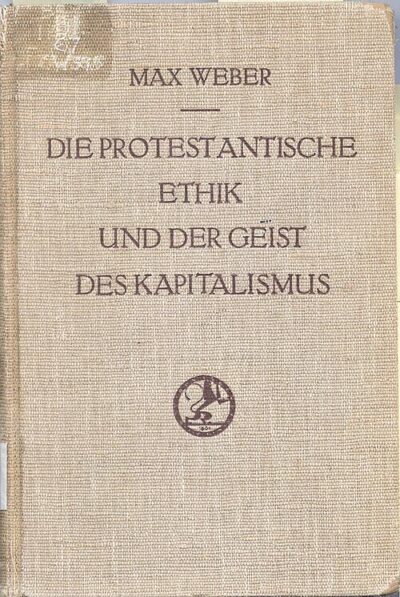
Picture: Cover designer unknown., via Wikimedia Commons · Public domain