The Revival of the Religious Sciences
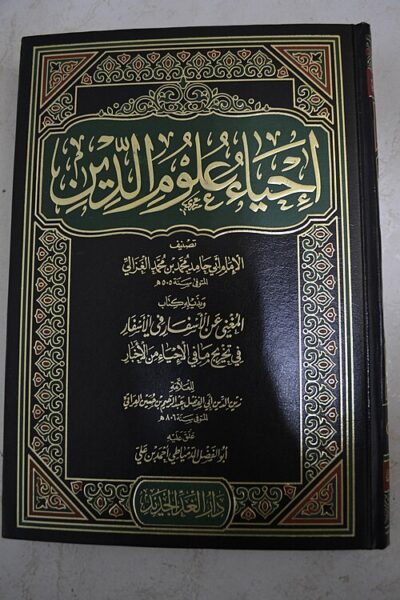
The Revival of the Religious Sciences is an Islamic theological work written by Al-Ghazali between 1095 and 1105 in four parts of ten chapters each.
- Published
- 1105
- Written by
- Al-Ghazali
- Country of origin
- Iran
All 5 facts, and where they come from
Facts
5 facts · 0 confirmed by two sources · 1 cited · 4 from one source
Where this comes from
Papalocal keeps its own record. It started from these sources; what each one said is kept here as it was copied, so a change on their side never changes this page by itself. Tap one to read its version.
What Wikidata says · copied November 17, 2026 · revision 2554939157
- Described as
- Islamic theological work written by Al-Ghazali between 1095 and 1105 in four parts of ten chapters each
- Other names
- Revival of the Religious Sciences
- What it is
- written work
- Written by
- Al-Ghazali
- Published
- 1105 · 1 reference
- Language
- Arabic · 1 reference
- Country of origin
- Iran · 1 reference
- Wikipedias with a page
- 21
Wikidata item Q4165276 (wikidata.org/wiki/Q4165276), public domain (CC0). Copied 2026-11-17.
What Wikipedia says · copied November 17, 2026 · revision 1384439798
The Revival of the Religious Sciences (Arabic: إِحْيَاء عُلُوم ٱلدِّين, romanized: Iḥyāʾ ʿUlūm al-Dīn) is a 12th-century book written by the Muslim scholar al-Ghazali. The book was composed in Arabic by Ghazali on his spiritual crises that stemmed from his appointment as the head of the Nizamiyya of Baghdad in Baghdad, which led to his eventual disappearance from the Muslim world for over 10 years. It is widely considered to be the most influential book in Islamic history after the Quran and canonical hadith collections.
It is regarded as one of his chief works and a classic introduction to the pious Muslim's path to God. It originally spanned 40 volumes and dealt with Islamic concepts and practices, demonstrating how these might be formed the foundation of reflective religious life, thereby attaining the higher stages of Sufism. Some consider Kimiyā-ye Sa'ādat (Alchemy of Happiness) as a rewrite of this work, which is a common misconception. Kimyā-ye Sa'ādat is shorter than this book; however, Ghazali said that he wrote the former to reflect the nature of the latter and a few of his other theological writings.
From the Wikipedia article “The Revival of the Religious Sciences” (en.wikipedia.org/wiki/The_Revival_of_the_Religious_Sciences), by its contributors, under CC BY-SA 4.0 (creativecommons.org/licenses/by-sa/4.0/). Copied 2026-11-17; not changed.
Confirmed Two sources agree. Cited One source, and it names where it got it. One source One source, without a reference of its own. Sources disagree The sources disagree. We show the best-supported value and keep theirs below.
Picture: Imam Khairul Annas, via Wikimedia Commons · CC BY-SA 3.0