The Wealth of Nations
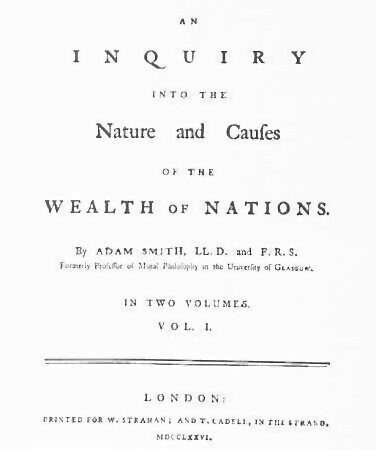
The Wealth of Nations is a 1776 work on economics by Adam Smith.
- Published
- March 9, 1776
- Written by
- Adam Smith
- Genre
- market
- Country of origin
- United Kingdom
All 8 facts, and where they come from
Facts
8 facts · 0 confirmed by two sources · 0 cited · 8 from one source
Where this comes from
Papalocal keeps its own record. It started from these sources; what each one said is kept here as it was copied, so a change on their side never changes this page by itself. Tap one to read its version.
What Wikidata says · copied November 17, 2026 · revision 2569724794
- Described as
- 1776 work on economics by Adam Smith
- Other names
- An Inquiry into the Nature and Causes of the Wealth of Nations
- What it is
- literary work
- Written by
- Adam Smith
- Genre
- market; essay · 1 reference
- Published
- March 9, 1776
- Language
- English
- Country of origin
- United Kingdom · 1 reference
- Comes after
- Lectures on Jurisprudence
- Wikipedias with a page
- 66
Wikidata item Q233562 (wikidata.org/wiki/Q233562), public domain (CC0). Copied 2026-11-17.
What Wikipedia says · copied November 17, 2026 · revision 1384231650
An Inquiry into the Nature and Causes of the Wealth of Nations, usually referred to by its shortened title The Wealth of Nations, is a book by Scottish economist and moral philosopher Adam Smith. Published on 9 March 1776 as Smith's central intellectual project, the treatise sought to examine and explain the underlying political and economic principles by which commercial and industrial societies generate wealth. It has become a fundamental work in classical economics, and been described as "the first formulation of a comprehensive system of political economy". Smith radically transformed economic thought, laying the foundations for policies that would produce unprecedented increases in productivity and wealth.
By the eighteenth century, much of the emerging world economy was dominated by the feudal and mercantilist institutions of the European powers. In Europe itself, feudalism still shaped economic life through hereditary privilege, guilds, and restrictions on labour and commerce, while internationally, mercantilism sought to increase national wealth through state intervention, colonial trading monopolies, protective tariffs, and restrictions on international trade. A product of the ideas of the stadial conception of history, spontaneous order and the empiricism of the Scottish Enlightenment, the treatise attempted to illustrate the growing contradiction between the inherited institutions and assumptions of Europe's feudal and mercantilist economic order and the changing realities of an increasingly commercial and industrial society. Smith argued that these policies rested upon fundamentally mistaken political and economic conceptions among European political and economic elites, arguing that they inadvertently hindered rather than promoted the creation of wealth. He rejected the prevailing view that wealth was acquired through zero-sum competition between imperial states, instead arguing that the creation of wealth was enabled through free exchange and competition between individuals, and the increasing productivity made possible by the division of labour.
Smith employed the now famous metaphor of an "invisible hand", whereby he imagined that individuals within a free market were moved by the "invisible hand" force of supply and demand, rather than the 'heavy hand' of the state. And that by doing so, these self-interested individuals moved towards unintended positive consequences, namely community welfare in the form of national wealth. Smith wrote: "By pursuing his own interest he frequently promotes that of the society."
In the treatise, Smith not only critiqued the policies attributed to feudalism and mercantilism, but also other political and economic phenomena. He vehemently criticized slavery, rent-seeking by landed interests and landlords (for which he instead suggested a land value tax), primogeniture, entails, public debt, and military expenditure for imperialistic purposes.
Although The Wealth of Nations did not immediately transform policy, the book became one of the most influential books in modern history. The work represented a clear paradigm shift from the previous economic thought. Although Smith did not use the term "capitalism", the book fundamentally shaped the field of economics and provided the theoretical foundation for capitalism and economic policies that later prevailed in the 19th century. Karl Marx would later go on to write "...the Wealth of Nations is the true Bible of the classical political economy of the 18th century." The treatise is widely regarded as a foundational work of economic liberalism, with virtually all liberal economic schools embracing, reinterpretating or synthesizing Smith's concepts. Beyond the liberal tradition, Marxian economics developed as a critique of the tradition of classical political economy established in The Wealth of Nations, while adapting many of Smith's analytical concepts, such as the division of labour, economic classes, the labour theory of value, capital accumulation, the hypothesis of the tendency of the rate of profit to fall, and the distinction between wages, profit, and rent.
From the Wikipedia article “The Wealth of Nations” (en.wikipedia.org/wiki/The_Wealth_of_Nations), by its contributors, under CC BY-SA 4.0 (creativecommons.org/licenses/by-sa/4.0/). Copied 2026-11-17; not changed.
Confirmed Two sources agree. Cited One source, and it names where it got it. One source One source, without a reference of its own. Sources disagree The sources disagree. We show the best-supported value and keep theirs below.
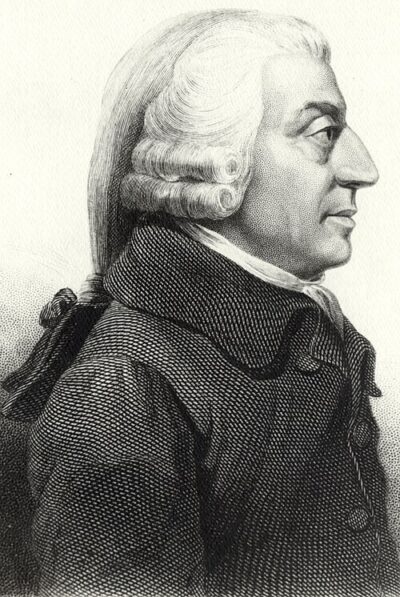
Picture: Gerhard Streminger, via Wikimedia Commons · Public domain