
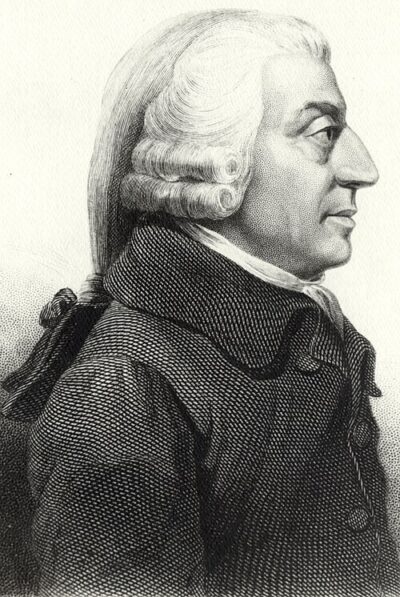
Adam Smith
Adam Smith was a Scottish moral philosopher and political economist. Born June 1723, in Kirkcaldy. Died July 17, 1790, in Edinburgh. Known for The Theory of Moral Sentiments and The Wealth of Nations. Educated at University of Glasgow and Balliol College. Awards include Fellow of the Royal Society, Fellow of the Royal Society of Arts and Fellow of the Royal Society of Edinburgh.
Facts
36 facts · 2 confirmed by two sources · 13 cited · 21 from one source
Where this comes from
Papalocal keeps its own record. It started from these sources; what each one said is kept here as it was copied, so a change on their side never changes this page by itself. Tap one to read its version.
What Wikidata says · copied November 16, 2026 · revision 2569720945
- Described as
- Scottish moral philosopher and political economist (1723–1790)
- Other names
- Smiths
- Born
- June 1723
- Died
- July 17, 1790 · 11 references
- Born in
- Kirkcaldy · 2 references
- Died in
- Edinburgh · 2 references
- Buried in
- Canongate Kirkyard
- Citizen of
- Kingdom of Great Britain
- Occupation
- economist · 1 reference; non-fiction writer; philosopher · 1 reference; writer · 1 reference; university teacher · 1 reference; moralist; publisher; Master's Degree in Economics · 1 reference
- Worked for
- University of Edinburgh; University of Glasgow (1751–1763)
- Education
- University of Glasgow; Balliol College
- Member of
- Royal Society of London (1767–); Royal Society of Edinburgh; The Select Society; The Poker Club
- Known for
- The Theory of Moral Sentiments · 1 reference; The Wealth of Nations
- Awards
- Fellow of the Royal Society (1767) · 1 reference; Fellow of the Royal Society of Arts; Fellow of the Royal Society of Edinburgh (1783) · 1 reference
- Field
- economics; ethics; political philosophy; economic theory; economic liberalism; philosophy · 1 reference
- Father
- Adam Smith · 2 references
- Mother
- Margaret Douglas · 1 reference
- Religion
- deism
- Wikipedias with a page
- 226
Wikidata item Q9381 (wikidata.org/wiki/Q9381), public domain (CC0). Copied November 16, 2026.
What Wikipedia says · copied November 16, 2026 · revision 1385795865
Adam Smith (baptised 16 June [O.S. 5 June] 1723 – 17 July 1790) was a Scottish economist and philosopher who was a pioneer in the field of political economy and key figure during the Scottish Enlightenment. Seen by many as the "father of economics", or the "father of capitalism", he is primarily known for two classic works: The Theory of Moral Sentiments (1759) and An Inquiry into the Nature and Causes of the Wealth of Nations (1776). The latter, often abbreviated as The Wealth of Nations, is regarded as his magnum opus, marking the inception of modern economic scholarship as a comprehensive system and an academic discipline. Smith refuses to explain the distribution of wealth and power in terms of divine will and instead appeals to natural, political, social, economic, legal, environmental and technological factors, as well as the interactions among them. The work is notable for its contribution to economic theory, particularly in its exposition of the concept of absolute advantage.
Born in Kirkcaldy, Fife, he studied social philosophy at the University of Glasgow and at the University of Oxford, where he was one of the only students to benefit from scholarships set up by John Snell. Following his graduation, he delivered a successful series of public lectures at the University of Edinburgh, that met with acclaim. This led to a collaboration with David Hume during the Scottish Enlightenment. Smith obtained a professorship at Glasgow, where he taught moral philosophy. During this period, he wrote and published The Theory of Moral Sentiments. Subsequently, he assumed a tutoring position that facilitated travel throughout Europe, where he encountered intellectual figures of his era.
In response to the prevailing policy of safeguarding national markets and merchants through the reduction of imports and the augmentation of exports, a practice that came to be known as mercantilism, Smith laid the foundational principles of classical free-market economic theory. The Wealth of Nations was a precursor to the modern academic discipline of economics. In this and other works, he developed the concept of division of labour and expounded upon how rational self-interest and competition can lead to economic prosperity. Smith was controversial in his day and his general approach and writing style were often satirised by writers such as Horace Walpole.
- Born, in its opening lines
- June 16, 1723
- Died, in its opening lines
- July 17, 1790
From the Wikipedia article “Adam Smith” (en.wikipedia.org/wiki/Adam_Smith), by its contributors, under CC BY-SA 4.0 (creativecommons.org/licenses/by-sa/4.0/). Copied November 16, 2026; not changed.
Confirmed Two sources agree. Cited One source, and it names where it got it. One source One source, without a reference of its own. Sources disagree The sources disagree. We show the best-supported value and keep theirs below.
