The Yellow Christ
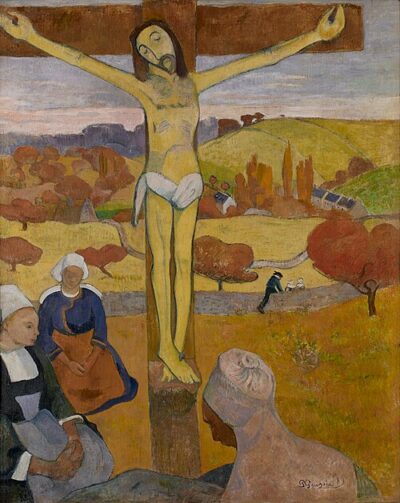
The Yellow Christ is a painting by Paul Gauguin. It came out in 1889. It is based on Chapelle de Trémalo.
- Came out
- 1889
- Created by
- Paul Gauguin
- Genre
- religious art
- Country of origin
- French Third Republic
All 9 facts, and where they come from
Facts
9 facts · 0 confirmed by two sources · 5 cited · 4 from one source
Where this comes from
Papalocal keeps its own record. It started from these sources; what each one said is kept here as it was copied, so a change on their side never changes this page by itself. Tap one to read its version.
What Wikidata says · copied November 17, 2026 · revision 2560734603
- Described as
- painting by Paul Gauguin
- Other names
- The Yellow Christ by Paul Gauguin, The Yellow Christ Paul Gauguin, The Yellow Christ (Paul Gauguin)
- What it is
- painting · 1 reference
- Created by
- Paul Gauguin · 1 reference
- Genre
- religious art · 1 reference
- Country of origin
- French Third Republic
- Based on
- Chapelle de Trémalo; crucifixion
- Came out
- 1889 · 1 reference
- Owned by
- Émile Schuffenecker · 1 reference; Gustave Fayet
- Wikipedias with a page
- 32
Wikidata item Q500951 (wikidata.org/wiki/Q500951), public domain (CC0). Copied 2026-11-17.
What Wikipedia says · copied November 17, 2026 · revision 1381074670
The Yellow Christ (French: Le Christ jaune) is a painting executed by Paul Gauguin in 1889 in Pont-Aven. Together with The Green Christ, it is considered to be one of the key works of Symbolist painting.
Gauguin first visited Pont-Aven in 1886. He returned to the village in early 1888 to stay until mid-October, when he left to join Vincent van Gogh in Arles, for little more than two months. Early in 1889, Gauguin was back to Pont-Aven to stay there until spring 1890. It was only for a short visit in summer 1889 to Paris to see the Exposition universelle and to arrange the Volpini Exhibition that Gauguin interrupted this sojourn. Soon after his return to Pont-Aven he painted The Yellow Christ.
The painting is a symbolic piece that shows the crucifixion of Jesus Christ taking place in 19th-century northern France as Breton women are gathered in prayer. Gauguin relies heavily on bold lines to define his figures and reserves shading only for the women. The autumn palette of yellow, red and green in the landscape echoes the dominant yellow in the figure of Christ. The bold outlines and flatness of the forms in this painting are typical of the cloisonnist style.
A study for The Yellow Christ in pencil is preserved in the Thyssen-Bornemisza Museum, and a version in watercolor is in the collection of the Art Institute of Chicago, gift of Elizabeth F. Chapman.
From the Wikipedia article “The Yellow Christ” (en.wikipedia.org/wiki/The_Yellow_Christ), by its contributors, under CC BY-SA 4.0 (creativecommons.org/licenses/by-sa/4.0/). Copied 2026-11-17; not changed.
Confirmed Two sources agree. Cited One source, and it names where it got it. One source One source, without a reference of its own. Sources disagree The sources disagree. We show the best-supported value and keep theirs below.
Picture: Paul Gauguin, via Wikimedia Commons · Public domain