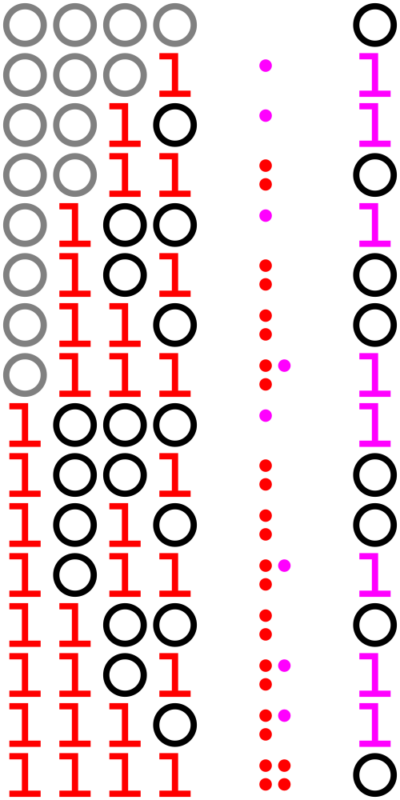
Thue–Morse sequence
Thue–Morse sequence is an infinite binary sequence generated by repeated complementation and concatenation.
All 5 facts, and where they come from
Facts
5 facts · 0 confirmed by two sources · 0 cited · 5 from one source
Where this comes from
Papalocal keeps its own record. It started from these sources; what each one said is kept here as it was copied, so a change on their side never changes this page by itself. Tap one to read its version.
What Wikidata says · copied November 17, 2026 · revision 2550667180
- Described as
- an infinite binary sequence generated by repeated complementation and concatenation
- Other names
- Prohuet-Thue-Morse sequence, Morse-Thue sequence
- What it is
- fractal; integer sequence; infinite sequence
- Named after
- Axel Thue; Marston Morse
- Wikipedias with a page
- 18
Wikidata item Q1477120 (wikidata.org/wiki/Q1477120), public domain (CC0). Copied 2026-11-17.
What Wikipedia says · copied November 17, 2026 · revision 1384708632
In mathematics, the Thue–Morse or Prouhet–Thue–Morse sequence is the binary sequence (an infinite sequence of 0s and 1s) that can be obtained by starting with 0 and successively appending the Boolean complement of the sequence obtained thus far. It is sometimes called the fair share sequence because of its applications to fair division or parity sequence. The first few steps of this procedure yield the strings 0, 01, 0110, 01101001, 0110100110010110, and so on, which are the prefixes of the Thue–Morse sequence. The full sequence begins:
01101001100101101001011001101001...
The sequence is named after Axel Thue, Marston Morse and (in its extended form) Eugène Prouhet.
From the Wikipedia article “Thue–Morse sequence” (en.wikipedia.org/wiki/Thue–Morse_sequence), by its contributors, under CC BY-SA 4.0 (creativecommons.org/licenses/by-sa/4.0/). Copied 2026-11-17; not changed.
Confirmed Two sources agree. Cited One source, and it names where it got it. One source One source, without a reference of its own. Sources disagree The sources disagree. We show the best-supported value and keep theirs below.
Picture: Opensofias, via Wikimedia Commons · CC0