
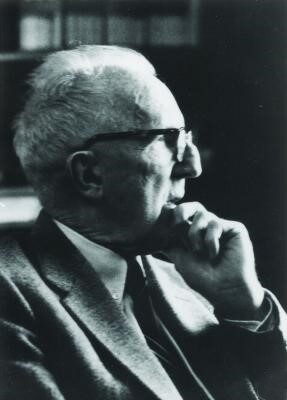
Marston Morse
Marston Morse was an American mathematician. Born March 24, 1892, in Waterville. Died June 22, 1977, in Princeton. Positions held include chairperson (1941–1942). Known for Morse theory, Morse function and Morse–Palais lemma. Educated at Harvard University and Colby College. Awards include Croix de guerre 1914–1918, Bôcher Memorial Prize and doctor honoris causa from the University of Paris.
Facts
45 facts · 2 confirmed by two sources · 25 cited · 18 from one source
Where this comes from
Papalocal keeps its own record. It started from these sources; what each one said is kept here as it was copied, so a change on their side never changes this page by itself. Tap one to read its version.
What Wikidata says · copied November 15, 2026 · revision 2567283684
- Described as
- American mathematician (1892–1977)
- Other names
- H. Marston Morse, H. C. Marston Morse, Harold Marston Morse, M. Morse, Morse M, Harold Calvin Marston Morse
- Born
- March 24, 1892 · 6 references
- Died
- June 22, 1977 · 6 references
- Born in
- Waterville · 1 reference
- Died in
- Princeton · 1 reference
- Buried in
- Pine Grove Cemetery · 2 references
- Name at birth
- Harold Calvin Marston Morse
- Citizen of
- United States
- Occupation
- mathematician · 1 reference; topologist; university teacher
- Positions held
- chairperson (1941–1942) · 1 reference
- Worked for
- Institute for Advanced Study (1935–1962) · 1 reference; Harvard University (2 times) (1919–1935) · 1 reference; Cornell University (1920–1925) · 1 reference; Brown University (1925–1926) · 1 reference
- Education
- Harvard University (1914–1917) · 1 reference; Colby College (1910–1914) · 1 reference; Coburn Classical Institute (1910) · 1 reference
- Member of
- Heidelberg Academy of Sciences and Humanities (1950–) · 1 reference; National Academy of Sciences (1932–) · 1 reference; American Academy of Arts and Sciences (1929–) · 1 reference; Romanian Academy (1965–) · 1 reference; American Philosophical Society (1936–); Accademia Nazionale dei Lincei (1962–) · 1 reference; Polish Academy of Sciences · 1 reference
- Known for
- Morse theory; Morse function; Morse–Palais lemma; Morse homology; Thue–Morse sequence; Prouhet–Thue–Morse constant
- Awards
- Croix de guerre 1914–1918 (1919) · 1 reference; Bôcher Memorial Prize (1933) · 2 references; doctor honoris causa from the University of Paris (1946) · 1 reference; Josiah Willard Gibbs Lectureship (1952) · 1 reference; Knight of the Legion of Honour (1952) · 1 reference; honorary doctor of the University of Rennes (1953) · 1 reference; National Medal of Science (1964)
- Field
- topology; mathematics · 1 reference; calculus of variations · 1 reference; differential topology · 1 reference
- Spouse
- Louise Jefferys Morse · 2 references; Celeste Phelps
- Children
- Dryden Phelps Morse
- Wikipedias with a page
- 26
Wikidata item Q723627 (wikidata.org/wiki/Q723627), public domain (CC0). Copied November 15, 2026.
What Wikipedia says · copied November 15, 2026 · revision 1372522446
Harold Calvin Marston Morse (March 24, 1892 – June 22, 1977) was an American mathematician best known for his work on the calculus of variations in the large, a subject where he introduced the technique of differential topology now known as Morse theory. The Morse–Palais lemma, one of the key results in Morse theory, is named after him, as is the Thue–Morse sequence, an infinite binary sequence with many applications.
He was elected to the American Academy of Arts and Sciences in 1929, the United States National Academy of Sciences in 1932, and the American Philosophical Society in 1936. In 1933 he was awarded the Bôcher Memorial Prize for his work in mathematical analysis. J. Robert Oppenheimer described Morse as "almost a statesman of mathematics."
- Born, in its opening lines
- March 24, 1892
- Died, in its opening lines
- June 22, 1977
From the Wikipedia article “Marston Morse” (en.wikipedia.org/wiki/Marston_Morse), by its contributors, under CC BY-SA 4.0 (creativecommons.org/licenses/by-sa/4.0/). Copied November 15, 2026; not changed.
Confirmed Two sources agree. Cited One source, and it names where it got it. One source One source, without a reference of its own. Sources disagree The sources disagree. We show the best-supported value and keep theirs below.
