
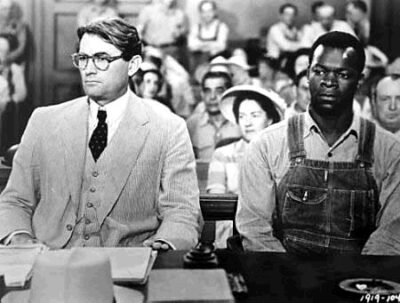
To Kill a Mockingbird
To Kill a Mockingbird is a 1962 film by Robert Mulligan. It stars Gregory Peck, Mary Badham and Phillip Alford. It won the Academy Award for Best Actor and 3 more.
- Released
- December 20, 1962
- Directed by
- Robert Mulligan
- Genre
- drama film
- Country of origin
- United States
All 27 facts, and where they come from
Facts
27 facts · 0 confirmed by two sources · 16 cited · 11 from one source
Where this comes from
Papalocal keeps its own record. It started from these sources; what each one said is kept here as it was copied, so a change on their side never changes this page by itself. Tap one to read its version.
What Wikidata says · copied November 17, 2026 · revision 2568307186
- Described as
- 1962 film by Robert Mulligan
- What it is
- film
- Directed by
- Robert Mulligan · 6 references
- Music by
- Elmer Bernstein
- Screenplay by
- Horton Foote
- Produced by
- Robert Mulligan; Alan J. Pakula
- Starring
- Gregory Peck · 6 references; Mary Badham · 6 references; Phillip Alford · 6 references; Robert Duvall · 4 references; John Megna · 4 references; Alice Ghostley · 3 references; William Windom · 3 references; Frank Overton · 4 references; Brock Peters · 5 references; Paul Fix · 3 references
- Genre
- drama film · 2 references; trial film; crime film · 1 reference
- Released
- December 20, 1962 · 1 reference; December 25, 1962 · 1 reference; February 11, 1963 · 1 reference
- Original language
- English
- Country of origin
- United States
- Based on
- To Kill a Mockingbird
- Awards
- Academy Award for Best Actor (1963) · 1 reference; Academy Award for Best Writing, Adapted Screenplay (1963) · 1 reference; Academy Award for Best Art Direction, Black and White (1963) · 1 reference; Golden Globe Award for Best Film Promoting International Understanding (1963) · 1 reference
- Wikipedias with a page
- 55
Wikidata item Q177922 (wikidata.org/wiki/Q177922), public domain (CC0). Copied 2026-11-17.
What Wikipedia says · copied November 17, 2026 · revision 1385268104
To Kill a Mockingbird is a 1962 American legal drama crime film directed by Robert Mulligan and starring Gregory Peck and Mary Badham. Adapted from Harper Lee's 1960 Pulitzer Prize–winning novel To Kill a Mockingbird, the film follows lawyer Atticus Finch in Depression-era Alabama educating his children against the Jim Crow laws while defending a black man who is wrongfully indicted for the rape of a white woman.
The film won overwhelmingly positive reception from both the critics and the public; a box-office success, it earned more than six times its budget. The film was awarded three Academy Awards, including Best Actor and Best Adapted Screenplay, and was nominated for eight, including Best Picture, Best Director, and Best Supporting Actress.
In 1995, the film was selected by the Library of Congress for preservation in the National Film Registry as "culturally, historically, or aesthetically significant". In 2003, the American Film Institute named Atticus Finch the greatest movie hero of the 20th century. In 2007, the film ranked twenty-fifth on the AFI's 10th anniversary list of the greatest American movies of all time. In 2008, the film ranked first on the AFI's list of the ten greatest courtroom dramas. In 2020, the British Film Institute included it in their list of the 50 films you should see by the age of 15. The film was restored and released on Blu-ray and DVD in 2012, as part of the 100th anniversary of Universal Pictures.
From the Wikipedia article “To Kill a Mockingbird (film)” (en.wikipedia.org/wiki/To_Kill_a_Mockingbird_(film)), by its contributors, under CC BY-SA 4.0 (creativecommons.org/licenses/by-sa/4.0/). Copied 2026-11-17; not changed.
Confirmed Two sources agree. Cited One source, and it names where it got it. One source One source, without a reference of its own. Sources disagree The sources disagree. We show the best-supported value and keep theirs below.
Picture: Moni3, via Wikimedia Commons · Public domain
