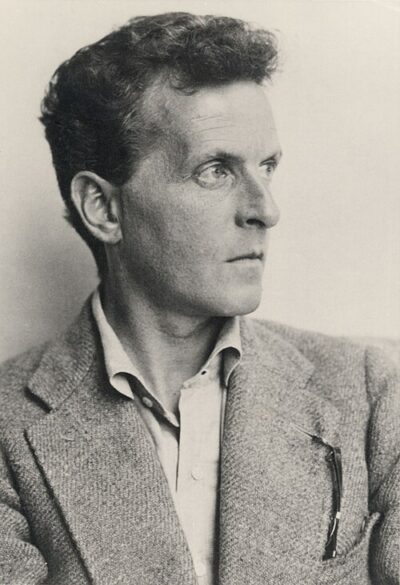
Tractatus Logico-Philosophicus
Tractatus Logico-Philosophicus is a philosophical work by Wittgenstein. It came out in 1921. It was written by Ludwig Wittgenstein.
- Published
- 1921
- Written by
- Ludwig Wittgenstein
- Genre
- essay
- Country of origin
- Austria
All 9 facts, and where they come from
Facts
9 facts · 0 confirmed by two sources · 0 cited · 9 from one source
Where this comes from
Papalocal keeps its own record. It started from these sources; what each one said is kept here as it was copied, so a change on their side never changes this page by itself. Tap one to read its version.
What Wikidata says · copied November 17, 2026 · revision 2559803429
- Described as
- philosophical work by Wittgenstein
- Other names
- Logical Philosophical Treatise, Treatise on Logic and Philosophy, Logisch-Philosophische Abhandlung
- What it is
- doctoral thesis; literary work
- Written by
- Ludwig Wittgenstein
- Genre
- essay; philosophical non-fiction literature; philosophy of language · 1 reference
- Published
- 1921; 1922; 1929
- Language
- German
- Country of origin
- Austria
- Wikipedias with a page
- 46
Wikidata item Q655717 (wikidata.org/wiki/Q655717), public domain (CC0). Copied 2026-11-17.
What Wikipedia says · copied November 17, 2026 · revision 1384800435
The Tractatus Logico-Philosophicus (widely abbreviated and cited as TLP) is the only book-length philosophical work by the Austrian philosopher Ludwig Wittgenstein that was published during his lifetime. The project had a broad goal: to identify the relationship between language and reality, and to define the limits of science. Wittgenstein wrote the notes for the Tractatus while he was a soldier during World War I and completed it during a military leave in the summer of 1918. It was originally published in German in 1921 as Logisch-Philosophische Abhandlung (Logical-Philosophical Treatise). In 1922 it was published together with an English translation and a Latin title, which was suggested by G. E. Moore as homage to Baruch Spinoza's Tractatus Theologico-Politicus (1670).
The Tractatus is written in an austere and succinct literary style, containing almost no arguments as such, but consists of 525 declarative statements, which are hierarchically numbered.
The Tractatus is recognized by philosophers as one of the most significant philosophical works of the twentieth century and was influential among the logical positivists of the Vienna Circle, such as Rudolf Carnap and Friedrich Waismann. It also influenced Bertrand Russell's article "The Philosophy of Logical Atomism".
Wittgenstein's later works, notably the posthumously published Philosophical Investigations, criticised many of his ideas in the Tractatus. There is nevertheless a common thread in Wittgenstein's thinking. Indeed, the contrast between 'early' and 'late' Wittgenstein has been countered by such scholars as Pears (1987) and Hilmy (1987). For example, a relevant, yet neglected aspect of continuity in Wittgenstein's thought concerns 'meaning as use'. Connecting his early and later writings on 'meaning as use' is his appeal to direct consequences of a term or phrase, reflected, for example, in his speaking of language as a 'calculus'. These passages are crucial to Wittgenstein's view of 'meaning as use', though they have been widely neglected in scholarly literature. The centrality and importance of these passages are corroborated and augmented by renewed examination of Wittgenstein's Nachlaß, as is done in, for example, "From Tractatus to Later Writings and Back – New Implications from Wittgenstein's Nachlass" (de Queiroz 2023), "From the Notebooks to the Investigations and Beyond" (de Queiroz 2025a) and "Meaning as Use, Application, Employment, Purpose, Usefulness" (de Queiroz 2025b).
From the Wikipedia article “Tractatus Logico-Philosophicus” (en.wikipedia.org/wiki/Tractatus_Logico-Philosophicus), by its contributors, under CC BY-SA 4.0 (creativecommons.org/licenses/by-sa/4.0/). Copied 2026-11-17; not changed.
Confirmed Two sources agree. Cited One source, and it names where it got it. One source One source, without a reference of its own. Sources disagree The sources disagree. We show the best-supported value and keep theirs below.
Picture: Wikimedia Commons: Tractatus title page 1922 Harcourt.png · See Commons file page