
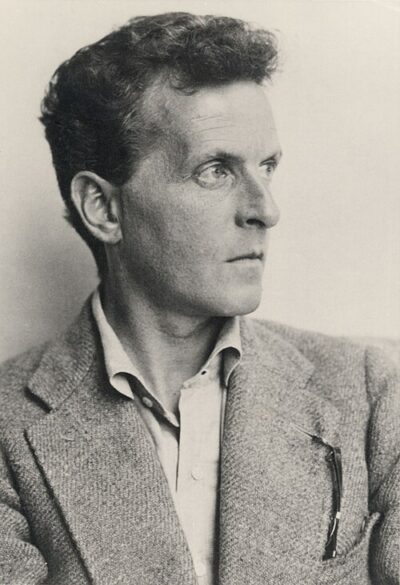
Ludwig Wittgenstein
Ludwig Wittgenstein was an Austrian philosopher and logician. Born April 26, 1889, in Neuwaldegg. Died April 29, 1951, in Cambridge. Known for Tractatus Logico-Philosophicus and Philosophical Investigations. Educated at Bundesrealgymnasium Linz Fadingerstraße and Technische Universität Berlin. Awards include Medal for Bravery.
Facts
42 facts · 2 confirmed by two sources · 22 cited · 18 from one source
Where this comes from
Papalocal keeps its own record. It started from these sources; what each one said is kept here as it was copied, so a change on their side never changes this page by itself. Tap one to read its version.
What Wikidata says · copied November 16, 2026 · revision 2569326569
- Described as
- Austrian philosopher and logician (1889–1951)
- Other names
- Wittgenstein, Ludwig Josef Johann Wittgenstein, Ludwig Joseph Johann Wittgenstein
- Born
- April 26, 1889 · 16 references
- Died
- April 29, 1951 · 16 references
- Born in
- Neuwaldegg · 2 references
- Died in
- Cambridge · 5 references
- Buried in
- Ascension Parish Burial Ground · 3 references
- Cause of death
- prostate cancer · 2 references
- Citizen of
- United Kingdom (1938–) · 1 reference; Austria (–1938)
- Occupation
- philosopher of language; architectural theoretician; logician; mathematician; aphorist; epistemologist; philosopher · 3 references; teacher · 1 reference
- Worked for
- Trinity College (1929–1947); University of Cambridge (1939–1947) · 1 reference
- Education
- Bundesrealgymnasium Linz Fadingerstraße (1903–1906) · 1 reference; Technische Universität Berlin (1906–1908) · 1 reference; Victoria University of Manchester (1908–1911) · 1 reference; Trinity College (1911–1913) · 2 references; University of Cambridge · 1 reference; Technische Hochschule Berlin (1906–1908) · 1 reference
- Instrument
- clarinet
- Known for
- Tractatus Logico-Philosophicus (1921); Philosophical Investigations (1953)
- Awards
- Medal for Bravery · 1 reference
- Field
- philosophy
- Father
- Karl Wittgenstein · 1 reference
- Mother
- Leopoldine Wittgenstein · 1 reference
- Siblings
- Margaret Stonborough-Wittgenstein · 1 reference; Paul Wittgenstein · 1 reference; Johannes Wittgenstein · 1 reference; Rudolf Wittgenstein · 1 reference; Konrad Wittgenstein · 1 reference; Dora Wittgenstein · 1 reference; Helene Wittgenstein · 1 reference; Hermine Wittgenstein · 1 reference
- Lived in
- Skjolden (1913–1914); Wiener Neustadt (1921–1925)
- Website
- http://www.wittgen-cam.ac.uk
- Wikipedias with a page
- 174
Wikidata item Q9391 (wikidata.org/wiki/Q9391), public domain (CC0). Copied November 16, 2026.
What Wikipedia says · copied November 16, 2026 · revision 1385796667
Ludwig Josef Johann Wittgenstein ( VIT-gən-s(h)tyne; Austrian German: [ˈluːdvɪk ˈjoːsɛf ˈjoːhan ˈvɪtɡn̩ʃtaɪn]; 26 April 1889 – 29 April 1951) was an Austro-British philosopher who worked in logic, philosophy of mathematics, philosophy of mind, and philosophy of language.
Wittgenstein was born in Vienna into one of Europe's richest families. From 1911 to 1913, he studied at the University of Cambridge under Bertrand Russell and interacted closely with John Maynard Keynes and G. E. Moore, among others. During this time, he inherited a fortune, part of which he donated to various poets and artists and the rest of which he gave to his siblings. He also began what would become his first important philosophical work. However, at the start of World War I, he left academia to enlist in the Austro-Hungarian Army. After a series of personal adversities—including the death of his older brother by suicide (the third of his older brothers to die by suicide during his lifetime), the death of his close friend and perhaps lover David Pinsent, and his imprisonment in an Italian prisoner of war camp—he became depressed. He worked as a schoolteacher around Vienna. Despite these setbacks, his philosophical work was published in the Tractatus Logico-Philosophicus in 1921, followed by an English translation in 1922 with help from Frank P. Ramsey, to considerable discussion and acclaim.
At the encouragement of Russell, Keynes, and Ramsey, Wittgenstein returned to Cambridge, where he taught from 1930 to 1947, giving lectures on philosophy, often permeated by his original research. During World War II, he left academia again to work at the Guy's Hospital in London and at the Royal Victoria Infirmary in Newcastle upon Tyne. Wittgenstein would not publish another philosophical work during his lifetime, but following his death in 1951, his voluminous manuscripts were edited and published posthumously. The first and best-known of this posthumous series is the 1953 book Philosophical Investigations.
Wittgenstein's philosophy is often divided into an early period, exemplified by the Tractatus, and a later period, articulated primarily in the Philosophical Investigations. The early Wittgenstein was concerned with the logical relationship between propositions and the world, and he believed that by providing an account of the logic underlying this relationship, he had solved all philosophical problems. The later Wittgenstein rejected many of the assumptions of the Tractatus, arguing that the meaning of words is best understood as their use within a given language game.
Wittgenstein was well regarded among academics during his lifetime, and was decorated for his courage during World War I. However, he encountered controversy during his time as a primary school teacher in rural Austria in the 1920s for his use of violent corporal punishment on girls and boys (see the Haidbauer incident). His work (both early and later) has been described as controversial and sparked a number of different reactions. Later philosophers and commentators have generally agreed that he is one of the most important figures in 20th-century philosophy.
- Born, in its opening lines
- April 26, 1889
- Died, in its opening lines
- April 29, 1951
From the Wikipedia article “Ludwig Wittgenstein” (en.wikipedia.org/wiki/Ludwig_Wittgenstein), by its contributors, under CC BY-SA 4.0 (creativecommons.org/licenses/by-sa/4.0/). Copied November 16, 2026; not changed.
Confirmed Two sources agree. Cited One source, and it names where it got it. One source One source, without a reference of its own. Sources disagree The sources disagree. We show the best-supported value and keep theirs below.
