Traité Élémentaire de Chimie
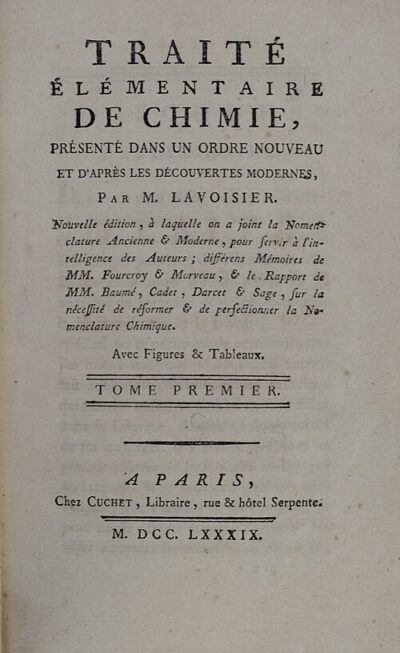
Traité Élémentaire de Chimie is a book by Antoine Lavoisier. It came out in 1789.
- Published
- 1789
- Written by
- Antoine Lavoisier
- Genre
- academic writing
- Country of origin
- France
All 7 facts, and where they come from
Facts
7 facts · 0 confirmed by two sources · 0 cited · 7 from one source
Where this comes from
Papalocal keeps its own record. It started from these sources; what each one said is kept here as it was copied, so a change on their side never changes this page by itself. Tap one to read its version.
What Wikidata says · copied November 17, 2026 · revision 2560750301
- Described as
- book by Antoine Lavoisier
- Other names
- Traite Elementaire de Chimie
- What it is
- scientific work; literary work
- Written by
- Antoine Lavoisier
- Genre
- academic writing
- Published
- 1789
- Language
- French
- Country of origin
- France
- Wikipedias with a page
- 15
Wikidata item Q2163561 (wikidata.org/wiki/Q2163561), public domain (CC0). Copied 2026-11-17.
What Wikipedia says · copied November 17, 2026 · revision 1384798298
Traité élémentaire de chimie is a textbook written by Antoine Lavoisier published in 1789 and translated into English by Robert Kerr in 1790 under the title Elements of Chemistry in a New Systematic Order containing All the Modern Discoveries. It is considered to be the first modern chemical textbook.
The book defines an element as a single substance that can't be broken down by chemical analysis and from which all chemical compounds are formed, publishing his discovery that fermentation produces carbon dioxide (carbonic gas) and spirit of wine, saying that it is "more appropriately called by the Arabic word alcohol since it is formed from cider or fermented sugar as well as wine", and publishing the first chemical equation "grape must = carbonic acid + alcohol", calling this reaction "one of the most extraordinary in chemistry", noting "In these experiments, we have to assume that there is a true balance or equation between the elements of the compounds with which we start and those obtained at the end of the chemical reaction."
The book contains 33 elements, only 23 of which are elements in the modern sense. The elements given by Lavoisier are: light, caloric, oxygen, azote (nitrogen), hydrogen, sulphur, phosphorous (phosphorus), charcoal, muriatic radical (chloride), fluoric radical (fluoride), boracic radical, antimony, arsenic, bismuth, cobalt, copper, gold, iron, lead, manganese, mercury, molybdena (molybdenite), nickel, platina (platinum), silver, tin, tungstein (tungsten), zinc, lime, magnesia (magnesium), barytes (baryte), argill (clay or earth of alum), and silex.The law of conservation of mass, which in France is taught as Lavoisier's Law, is paraphrased in the phrase "Rien ne se perd, rien ne se crée, tout se transforme." ("Nothing is lost, nothing is created, everything is transformed.")
From the Wikipedia article “Traité Élémentaire de Chimie” (en.wikipedia.org/wiki/Traité_Élémentaire_de_Chimie), by its contributors, under CC BY-SA 4.0 (creativecommons.org/licenses/by-sa/4.0/). Copied 2026-11-17; not changed.
Confirmed Two sources agree. Cited One source, and it names where it got it. One source One source, without a reference of its own. Sources disagree The sources disagree. We show the best-supported value and keep theirs below.
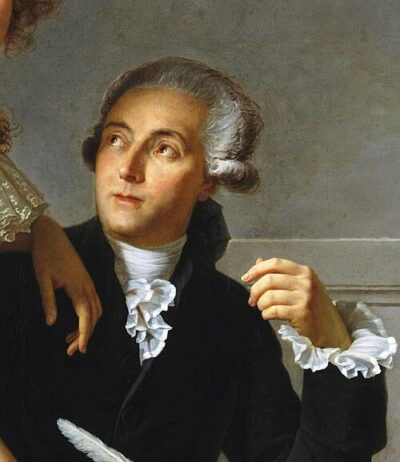
Picture: Lavoisier, Antoine-Laurent de, via Wikimedia Commons · Public domain