
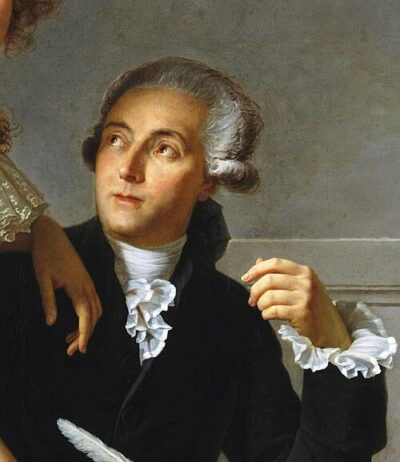
Antoine Lavoisier
Antoine Lavoisier was a French nobleman and chemist. Born August 26, 1743, in Paris. Died May 8, 1794, in place de la Concorde. Positions held include fermier général (1770–1774). Known for Traité Élémentaire de Chimie, Méthode de nomenclature chimique and conservation of mass. Educated at Paris Law Faculty. Awards include Fellow of the Royal Society, gold medal and Hommes illustres.
Facts
37 facts · 2 confirmed by two sources · 12 cited · 23 from one source
Where this comes from
Papalocal keeps its own record. It started from these sources; what each one said is kept here as it was copied, so a change on their side never changes this page by itself. Tap one to read its version.
What Wikidata says · copied November 16, 2026 · revision 2564344354
- Described as
- French nobleman and chemist (1743–1794)
- Other names
- Antoine Laurent Lavoisier, Lavoisier, Antoine Laurent de Lavoisier, Antoine-Laurent de Lavoisier
- Born
- August 26, 1743 · 12 references
- Died
- May 8, 1794 · 10 references
- Born in
- Paris · 4 references
- Died in
- place de la Concorde
- Buried in
- Errancis Cemetery
- Cause of death
- decapitation · 1 reference
- Citizen of
- France
- Occupation
- chemist · 2 references; economist; biologist · 1 reference; physicist; academic; lawyer · 1 reference; astronomer · 1 reference; writer · 1 reference
- Positions held
- fermier général (1770–1774)
- Worked for
- Ferme générale (1768–)
- Education
- Paris Law Faculty (1761–1764)
- Member of
- Royal Society of London (1788–) · 1 reference; Société Philomathique de Paris; French Academy of Sciences (1768–) · 1 reference; Paris Bar Association; American Philosophical Society (1775–) · 1 reference; Accademia Nazionale delle Scienze detta dei XL
- Known for
- Traité Élémentaire de Chimie; Méthode de nomenclature chimique; conservation of mass
- Awards
- Fellow of the Royal Society; gold medal (1766); Hommes illustres; 72 names on the Eiffel Tower · 1 reference; Concours général
- Field
- chemistry
- Spouse
- Mary-Anne Paulzzze Lavoisier (1771–1794) · 2 references
- Father
- Jean-Antoine Lavoisier · 1 reference
- Mother
- Emilie Punctis · 1 reference
- Religion
- Catholic Church
- Wikipedias with a page
- 129
Wikidata item Q39607 (wikidata.org/wiki/Q39607), public domain (CC0). Copied November 16, 2026.
What Wikipedia says · copied November 16, 2026 · revision 1383642189
Antoine-Laurent de Lavoisier ( lə-VWAH-zee-ay; French: [ɑ̃twan lɔʁɑ̃ də lavwazje]; 26 August 1743 – 8 May 1794), also Antoine Lavoisier after the French Revolution, was a French nobleman and chemist who was central to the 18th-century chemical revolution and who had a large influence on both the history of chemistry and the history of biology.
It is generally accepted that Lavoisier's great accomplishments in chemistry stem largely from his changing the science from a qualitative to a quantitative one.
Lavoisier is noted for his discovery of the role oxygen plays in combustion, opposing the prior phlogiston theory of combustion. He named oxygen (1778), recognizing it as an element, and also recognized hydrogen as an element (1783). By using more precise measurements than previous experimenters, he confirmed the developing theory that, although matter in a closed system may change its form or shape, its mass always remains the same (now known as the law of conservation of mass), which led to the development of the balanced physical and chemical reaction equations that are used today.
Lavoisier helped construct the metric system, wrote the first extensive list of elements, in which he predicted the existence of silicon, and helped to reform chemical nomenclature. (1787)
His wife and laboratory assistant, Marie-Anne Paulze Lavoisier, became a renowned chemist in her own right, and worked with him to develop the metric system of measurements.
Lavoisier was a powerful member of a number of aristocratic councils, and an administrator of the Ferme générale. The Ferme générale was one of the most hated components of the Ancien Régime because of the profits it took at the expense of the state, the secrecy of the terms of its contracts, and the violence of its armed agents. All of these political and economic activities enabled him to fund his scientific research. At the height of the French Revolution, he was charged with tax fraud and selling adulterated tobacco and was guillotined despite appeals to spare his life in recognition of his contributions to science. A year and a half later, he was exonerated by the French government.
- Born, in its opening lines
- August 26, 1743
- Died, in its opening lines
- May 8, 1794
From the Wikipedia article “Antoine Lavoisier” (en.wikipedia.org/wiki/Antoine_Lavoisier), by its contributors, under CC BY-SA 4.0 (creativecommons.org/licenses/by-sa/4.0/). Copied November 16, 2026; not changed.
Confirmed Two sources agree. Cited One source, and it names where it got it. One source One source, without a reference of its own. Sources disagree The sources disagree. We show the best-supported value and keep theirs below.
