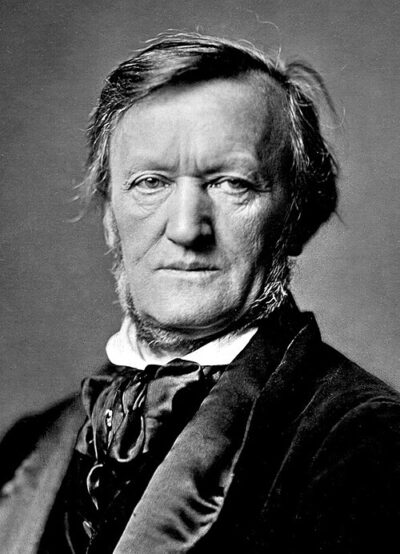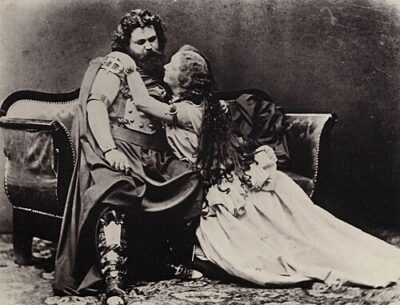
Tristan und Isolde
Tristan und Isolde is an opera by Richard Wagner. It came out in 1857.
- Released
- 19th century
- Came out
- 1857
- Genre
- opera
All 8 facts, and where they come from
Facts
8 facts · 0 confirmed by two sources · 3 cited · 5 from one source
Where this comes from
Papalocal keeps its own record. It started from these sources; what each one said is kept here as it was copied, so a change on their side never changes this page by itself. Tap one to read its version.
What Wikidata says · copied November 17, 2026 · revision 2552437367
- Described as
- opera by Richard Wagner
- Other names
- Tristan and Isolde, Tristan
- What it is
- dramatico-musical work
- Music by
- Richard Wagner · 2 references
- Screenplay by
- Gottfried von Strassburg · 1 reference
- Genre
- opera · 1 reference
- Released
- 19th century
- Language
- German
- Based on
- Tristan
- Came out
- 1857
- Wikipedias with a page
- 52
Wikidata item Q1324254 (wikidata.org/wiki/Q1324254), public domain (CC0). Copied 2026-11-17.
What Wikipedia says · copied November 17, 2026 · revision 1381560069
Tristan und Isolde (Tristan and Isolde), WWV 90, is a music drama in three acts by Richard Wagner set to a German libretto by the composer, loosely based on Gottfried von Strassburg's medieval 12th-century romance Tristan and Iseult. First conceived in 1854, the music was composed between 1857 and 1859 and premiered at the Königliches Hoftheater und Nationaltheater in Munich on 10 June 1865, with Hans von Bülow conducting. While it is performed by opera companies, Wagner preferred the term Handlung (German for "plot" or "action") for Tristan to distinguish its structure of continuous narrative flow ("endless melody") as distinct from that of conventional opera at the time, which consisted of recitatives punctuated by showpiece arias, which Wagner regarded with great disdain.
Tristan und Isolde was inspired in part by the philosophy of Arthur Schopenhauer, and by Wagner's relationship with his muse Mathilde Wesendonck. It explores existential themes such as that of mankind's insatiable striving and the transcendental nature of love beyond death, and incorporates spirituality from Christian mysticism as well as Vedantic and Buddhist metaphysics, subjects that interested Schopenhauer. Wagner was one of the earliest Western artists to use concepts from the Dharmic religions in their work.
Tristan und Isolde is widely acknowledged as one of the greatest achievements of Western art music, intriguing audiences with philosophical depths not usually associated with opera, and the "terrible and sweet infinity" of its musical-poetic language. Its advanced harmony, immediately announced by the Tristan chord of its prelude, marks a defining moment in the evolution of music, characterized by unprecedented use of chromaticism, tonal ambiguity, orchestral colour, and prolonged harmonic suspension. These innovations initially divided audiences, but the opera grew in popularity and became enormously influential among Western classical composers, directly inspiring Anton Bruckner, Gustav Mahler, Richard Strauss, Alban Berg, Arnold Schoenberg, and Benjamin Britten. Composers such as Claude Debussy, Maurice Ravel, and Igor Stravinsky formulated their styles in contrast to Wagner's musical legacy.
From the Wikipedia article “Tristan und Isolde” (en.wikipedia.org/wiki/Tristan_und_Isolde), by its contributors, under CC BY-SA 4.0 (creativecommons.org/licenses/by-sa/4.0/). Copied 2026-11-17; not changed.
Confirmed Two sources agree. Cited One source, and it names where it got it. One source One source, without a reference of its own. Sources disagree The sources disagree. We show the best-supported value and keep theirs below.
Picture: Josef Albert, via Wikimedia Commons · Public domain