Turing test
Turing test is a test of a machine's ability to exhibit intelligent behaviour equivalent to, or indistinguishable from, that of a human.
All 4 facts, and where they come from
Facts
4 facts · 0 confirmed by two sources · 0 cited · 4 from one source
Where this comes from
Papalocal keeps its own record. It started from these sources; what each one said is kept here as it was copied, so a change on their side never changes this page by itself. Tap one to read its version.
What Wikidata says · copied November 17, 2026 · revision 2568244387
- Described as
- test of a machine's ability to exhibit intelligent behaviour equivalent to, or indistinguishable from, that of a human
- Other names
- imitation Game
- What it is
- type of test; mathematical concept; computer science and engineering
- Named after
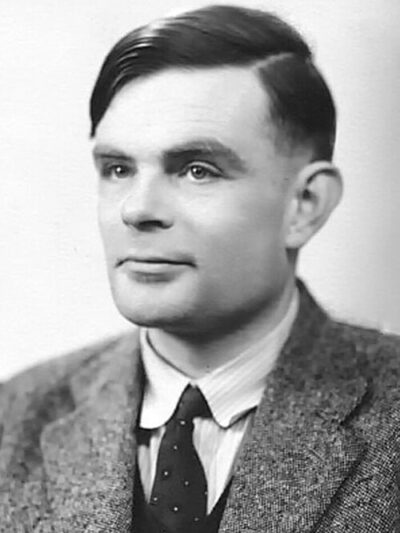
- Alan Turing
- Wikipedias with a page
- 69
Wikidata item Q189223 (wikidata.org/wiki/Q189223), public domain (CC0). Copied 2026-11-17.
What Wikipedia says · copied November 17, 2026 · revision 1385901893
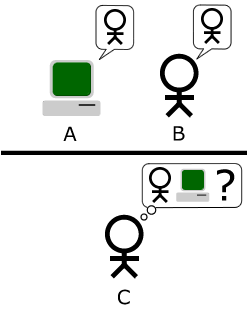
The Turing test was designed by Alan Turing to assess a machine's ability to exhibit intelligent behaviour equivalent to that of a human by imitating interactive dialogue. In the modern version, a human evaluator judges a text transcript of a natural-language conversation between a human and a machine. The evaluator tries to identify the machine, and the machine passes if the evaluator cannot reliably tell them apart. The results would not depend on the machine's ability to answer questions correctly, only on how closely its answers resembled those of a human. Since the Turing test is a test of indistinguishability in performance capacity, the original (verbal) version generalises naturally to all of human performance capacity, including nonverbal (robotic).
The test was introduced as the imitation game by Turing in his 1950 paper "Computing Machinery and Intelligence" while working at the University of Manchester. It opens with the words: "I propose to consider the question, 'Can machines think?'." Because "thinking" is difficult to define, Turing chooses to "replace the question by another, which is closely related to it and is expressed in relatively unambiguous words". Turing describes the new form of the problem in terms of a three-person party game called the "imitation game", in which an interrogator asks questions of a man and a woman in another room in order to determine the correct sex of the two players. Turing's new question is: "Are there imaginable digital computers which would do well in the imitation game?" This question, Turing believed, was one that could actually be answered. In the remainder of the paper, he argued against the major objections to the proposition that "machines can think".
Since Turing introduced his test, it has been highly influential in the philosophy of artificial intelligence, resulting in substantial discussion and controversy, as well as criticism from philosophers like John Searle, who argue against the test's ability to detect consciousness.
From the Wikipedia article “Turing test” (en.wikipedia.org/wiki/Turing_test), by its contributors, under CC BY-SA 4.0 (creativecommons.org/licenses/by-sa/4.0/). Copied 2026-11-17; not changed.
Confirmed Two sources agree. Cited One source, and it names where it got it. One source One source, without a reference of its own. Sources disagree The sources disagree. We show the best-supported value and keep theirs below.
Picture: Bilby, via Wikimedia Commons · Public domain