
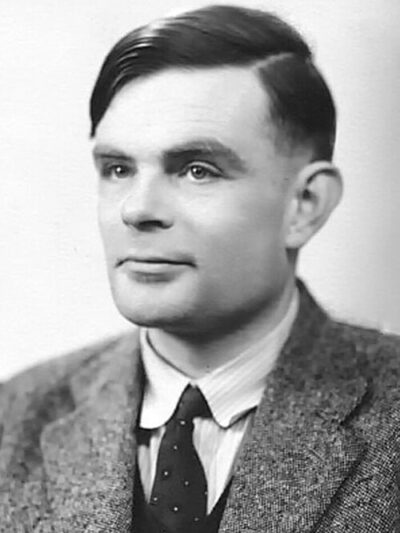
Alan Turing
Alan Turing was an English computer scientist. Born June 23, 1912, in Maida Vale. Died June 7, 1954, in Wilmslow. Known for On Computable Numbers, with an Application to the Entscheidungsproblem, Computing Machinery and Intelligence and Intelligent Machinery. Educated at Hazlehurst Community Primary School and Sherborne School. Awards include Fellow of the Royal Society, Officer of the Order of the British Empire and Smith's Prize.
Facts
50 facts · 2 confirmed by two sources · 21 cited · 27 from one source
Where this comes from
Papalocal keeps its own record. It started from these sources; what each one said is kept here as it was copied, so a change on their side never changes this page by itself. Tap one to read its version.
What Wikidata says · copied November 16, 2026 · revision 2568278235
- Described as
- English computer scientist (1912–1954)
- Other names
- Alan Mathieson Turing, Turing, Alan M. Turing, Alan Mathison Turing, A. M. Turing
- Born
- June 23, 1912 · 14 references
- Died
- June 7, 1954 · 14 references
- Born in
- Maida Vale · 1 reference
- Died in
- Wilmslow · 2 references
- Buried in
- Woking Crematorium · 2 references
- Cause of death
- cyanide poisoning · 1 reference
- Name at birth
- Alan Mathison Turing
- Citizen of
- United Kingdom
- Occupation
- computer scientist · 1 reference; mathematician · 2 references; university teacher; cryptographer; logician · 1 reference; statistician · 1 reference; marathon runner · 1 reference; artificial intelligence researcher
- Worked for
- Victoria University of Manchester (1948–1952) · 1 reference; Government Communications Headquarters (1938–1945) · 1 reference; University of Cambridge (1934–1937) · 1 reference; National Physical Laboratory (1945–1947)
- Education
- Hazlehurst Community Primary School (–1926) · 1 reference; Sherborne School (1926–1931) · 1 reference; King's College (1931–1934) · 1 reference; Princeton University (1937–1938)
- Member of
- Royal Society of London (1951–)
- Sport
- athletics
- Known for
- On Computable Numbers, with an Application to the Entscheidungsproblem · 1 reference; Computing Machinery and Intelligence · 1 reference; Intelligent Machinery · 1 reference; halting problem; Turing machine; Turing test; Turing completeness; Church–Turing thesis; universal Turing machine; Symmetric Turing machine
- Awards
- Fellow of the Royal Society (1951) · 2 references; Officer of the Order of the British Empire (1946) · 1 reference; Smith's Prize (1936)
- Field
- cryptanalysis; computer science; mathematics; logic; cryptography
- Father
- Julius Mathison Turing · 1 reference
- Mother
- Ethel Sara Stoney · 1 reference
- Religion
- atheism · 1 reference
- Lived in
- Maida Vale (1912–1927); Guildford (1927–)
- Website
- http://www.turingarchive.org/
- Wikipedias with a page
- 192
Wikidata item Q7251 (wikidata.org/wiki/Q7251), public domain (CC0). Copied November 16, 2026.
What Wikipedia says · copied November 16, 2026 · revision 1384962137
Alan Mathison Turing (; 23 June 1912 – 7 June 1954) was an English mathematician and logician widely regarded as the father of theoretical computer science. He formalised the concepts of algorithm and computation with the Turing machine, a model of a general-purpose computer, and his contributions to cryptanalysis helped the Allies of World War II decipher messages encrypted by the German Enigma machine. He also contributed the Turing test to philosophy of artificial intelligence and the Turing pattern concept to mathematical and theoretical biology.
Born in London and raised in southern England, Turing graduated from King's College, Cambridge, and earned a doctorate from Princeton University in 1938. During World War II, he worked at the Government Code and Cypher School at Bletchley Park, Britain's codebreaking centre, and focused on decrypting German naval messages as the head of Hut 8. His techniques improved on the pre-war Polish bomba method and hastened cryptanalysis of the Enigma ciphering system. The resulting intelligence, known as Ultra, proved helpful in the Battle of the Atlantic. After the war, Turing joined the National Physical Laboratory, where he designed the Automatic Computing Engine, an early stored-program computer.
In 1948, he joined Max Newman's Computing Machine Laboratory at the University of Manchester, contributing to the development of early Manchester computers. He also turned to mathematical biology, working on the chemical basis of morphogenesis and theorizing chemical oscillators independently of their experimental observation. In 1952, after acknowledging a sexual relationship with another man, Turing was prosecuted for gross indecency. He received probation conditional on chemical castration and lost his security clearance. He died on 7 June 1954, aged 41, by cyanide poisoning. The inquest ruled his death a suicide.
Turing left a lasting legacy in mathematics, computing, and codebreaking. His wartime work, covered by the Official Secrets Act, went unrecognised during his lifetime. He later received numerous honors and memorials. His death was examined and interpreted by his family and biographers, who variously accepted, supported, questioned, or disputed the inquest's verdict. Following a 2009 campaign, British prime minister Gordon Brown officially apologised for the "appalling way [Turing] was treated", and Queen Elizabeth II granted Turing a pardon in 2013. The Alan Turing law refers to part of a 2017 UK law that retroactively pardoned men cautioned or convicted under the criminalisation of homosexual acts.
- Born, in its opening lines
- June 23, 1912
- Died, in its opening lines
- June 7, 1954
From the Wikipedia article “Alan Turing” (en.wikipedia.org/wiki/Alan_Turing), by its contributors, under CC BY-SA 4.0 (creativecommons.org/licenses/by-sa/4.0/). Copied November 16, 2026; not changed.
Confirmed Two sources agree. Cited One source, and it names where it got it. One source One source, without a reference of its own. Sources disagree The sources disagree. We show the best-supported value and keep theirs below.
