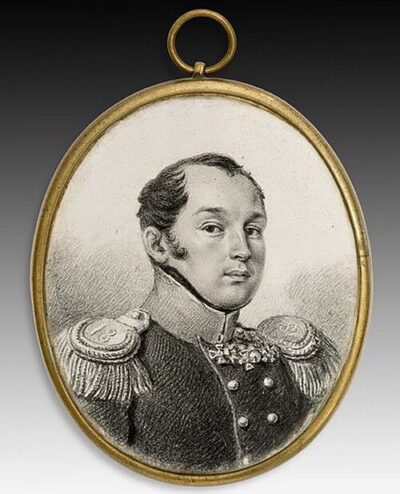
Union of Salvation
The Union of Salvation is a secret political society of the Decembrists. It was founded in 1816 by Alexander Muravyov. It stands for liberalism and constitutionalism.
- Founded
- February 9, 1816
- Founded by
- Alexander Muravyov
- Country
- Russian Empire
All 8 facts, and where they come from
Facts
8 facts · 0 confirmed by two sources · 0 cited · 8 from one source
Where this comes from
Papalocal keeps its own record. It started from these sources; what each one said is kept here as it was copied, so a change on their side never changes this page by itself. Tap one to read its version.
What Wikidata says · copied November 18, 2026 · revision 2501057620
- Described as
- secret political society of the Decembrists
- Other names
- Society of True and Loyal Sons of the Fatherland
- What it is
- political organization; secret society
- Founded
- February 9, 1816
- Ended
- 1818
- Founded by
- Alexander Muravyov
- Country
- Russian Empire
- Ideology
- liberalism; constitutionalism
- Wikipedias with a page
- 10
Wikidata item Q2492075 (wikidata.org/wiki/Q2492075), public domain (CC0). Copied 2026-11-18.
What Wikipedia says · copied November 18, 2026 · revision 1384283766
The Union of Salvation (Russian: Союз спасения, romanized: Sojuz spasenyja), formed in 1816, also known as the Society of True and Loyal Sons of the Fatherland (Russian: Общество истинных и верных сынов отечества, romanized: Obšestvo istinnych i vernych synov otečestva) since 1817, was the first secret political society of the Decembrists.
In 1816, at the initiative of Alexander Muravyov, a group of young officers of the Russian army founded the Union of Salvation (UoS). The first members had taken part in the Patriotic War of 1812 and in the foreign campaigns of 1813–1814. The UoS numbered some 30 members, including Nikita Muravyov, Sergey Muravyov-Apostol, Matvei Muravyov-Apostol, Sergei Trubetskoy, Ivan Yakushkin, Pavel Pestel, Yevgeni Obolensky, Ivan Pushchin, Mikhail Lunin and others. In 1817 they approved the UoS charter and changed the society's name to Society of True and Loyal Sons of the Fatherland. The UoS aimed at the abolition of serfdom and at the introduction of constitutional monarchy by means of armed revolt at the time of next emperor's succession to the throne. While preparing for the seizure of power, the UoS members had to try to expand the society's influence, secure key military and civil posts in government structures, and form public opinion.
The UoS members each belonged to one of three categories – bolyare (боляре), muzhi (мужи), and brat'ya (братья). The conspiracy operated in such a manner that only the first two categories of members knew the final purpose of the society. Low-ranking members had to obey high-ranking members implicitly. The admission of new members, as well as internal promotion, could only take place with the consent of the supreme council of the bolyare. Initiations and promotions were accomplished in strict accordance with a complex system of rituals and vows, adopted from Freemasonry.
There were two kind of groups within the UoS – radical and moderate. They debated over tactics and structure of the society, which some of them viewed as extremely secluded and complicated. UoS members came up with a number of regicide projects, but they were turned down due to the lack of funding and society's general unpreparedness for decisive action. In light of this, the majority of the members decided to vote for to dissolve the UoS and to establish a new organization, which would have more members and be more competent. They first created a transitional organization called Military Society ("Военное общество", or Voyennoye obshchestvo) and then in 1818 – the Union of Prosperity (Russian: Союз благоденствия, romanized: Soyuz blagodenstviya).
From the Wikipedia article “Union of Salvation” (en.wikipedia.org/wiki/Union_of_Salvation), by its contributors, under CC BY-SA 4.0 (creativecommons.org/licenses/by-sa/4.0/). Copied 2026-11-18; not changed.
Confirmed Two sources agree. Cited One source, and it names where it got it. One source One source, without a reference of its own. Sources disagree The sources disagree. We show the best-supported value and keep theirs below.
Picture: Wikimedia Commons: Kolman decembrists.jpg · See Commons file page