United States Naval Observatory
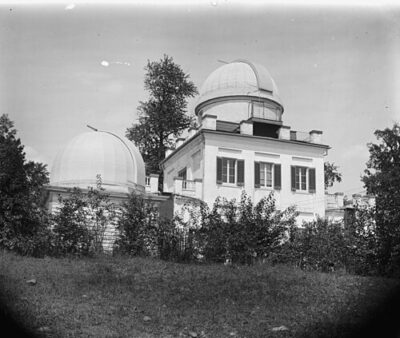
The United States Naval Observatory is a scientific agency and observatory in Washington, D.C., United States. It was founded in 1830.
- Founded
- 1830
- Country
- United States
All 6 facts, and where they come from
Facts
6 facts · 0 confirmed by two sources · 3 cited · 3 from one source
Where this comes from
Papalocal keeps its own record. It started from these sources; what each one said is kept here as it was copied, so a change on their side never changes this page by itself. Tap one to read its version.
What Wikidata says · copied November 17, 2026 · revision 2553517697
- Described as
- scientific agency and observatory in Washington, D.C., United States
- Other names
- U.S. Naval Observatory, US Naval Observatory, USNO, Depot of Charts and Instruments, Depot of Charts & Instruments
- What it is
- government agency; astronomical observatory
- Founded
- 1830 · 1 reference
- Located in
- Washington, D.C. · 2 references
- Country
- United States · 3 references
- Official website
- https://www.cnmoc.usff.navy.mil/usno/ · 1 reference
- Wikipedias with a page
- 28
Wikidata item Q11700 (wikidata.org/wiki/Q11700), public domain (CC0). Copied 2026-11-17.
What Wikipedia says · copied November 17, 2026 · revision 1384369732
The United States Naval Observatory (USNO) is a scientific and military facility that produces geopositioning, navigation and timekeeping data for the United States Navy and the United States Department of Defense. Established in 1830 as the Depot of Charts and Instruments, it is one of the oldest scientific agencies in the United States, and remains a leading facility for astronomical and timing data.
The observatory is located in Northwest Washington, D.C. at the northwestern end of Embassy Row. It is among the few pre-20th century astronomical observatories located in an urban area. In 1893, in an effort to escape light pollution, it was relocated from Foggy Bottom near the city's center, to its Northwest Washington, D.C. location.
The USNO has conducted significant scientific studies throughout its history, including measuring the speed of light, observing solar eclipses, and discovering the moons of Mars. Its achievements include providing data for the first radio time signals, constructing some of the earliest and most accurate telescopes of their kind, and helping develop universal time. The Naval Observatory performs radio VLBI-based positions of quasars for astrometry and geodesy with numerous global collaborators (IERS), in order to produce Earth orientation parameters and to realize the celestial reference system (ICRF).
Aside from its scientific mission, since the 1970s the Naval Observatory campus hosts the official residence of the vice president of the United States.
From the Wikipedia article “United States Naval Observatory” (en.wikipedia.org/wiki/United_States_Naval_Observatory), by its contributors, under CC BY-SA 4.0 (creativecommons.org/licenses/by-sa/4.0/). Copied 2026-11-17; not changed.
Confirmed Two sources agree. Cited One source, and it names where it got it. One source One source, without a reference of its own. Sources disagree The sources disagree. We show the best-supported value and keep theirs below.
Picture: National Photo Company Collection, via Wikimedia Commons · Public domain