
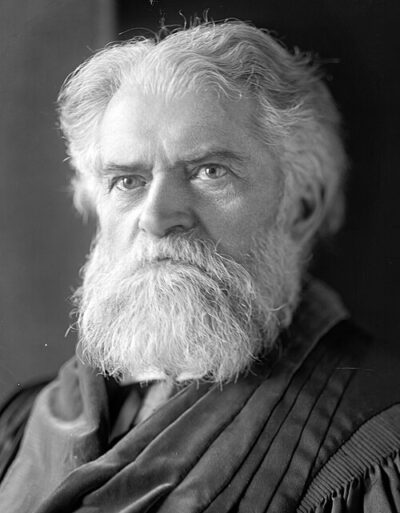
Simon Newcomb
Simon Newcomb was an American astronomer. Born March 12, 1835, in Wallace. Died July 11, 1909, in Washington, D.C.. Positions held include President of the American Mathematical Society (1897–1898) and chairperson (1899–1905). Educated at Harvard University. Awards include Knight of the Legion of Honour, Copley Medal and Pour le Mérite for Sciences and Arts order.
Facts
48 facts · 2 confirmed by two sources · 21 cited · 25 from one source
Where this comes from
Papalocal keeps its own record. It started from these sources; what each one said is kept here as it was copied, so a change on their side never changes this page by itself. Tap one to read its version.
What Wikidata says · copied November 13, 2026 · revision 2565557142
- Described as
- American astronomer (1835–1909)
- Born
- March 12, 1835 · 15 references
- Died
- July 11, 1909 · 13 references
- Born in
- Wallace · 3 references
- Died in
- Washington, D.C. · 4 references
- Buried in
- Arlington National Cemetery · 1 reference
- Cause of death
- cancer
- Citizen of
- Canada; United States
- Occupation
- astronomer · 1 reference; mathematician · 1 reference; economist; novelist; university teacher; science fiction writer; writer · 1 reference
- Positions held
- President of the American Mathematical Society (1897–1898) · 2 references; chairperson (1899–1905) · 1 reference
- Worked for
- Johns Hopkins University (1884–1893) · 1 reference; American Ephemeris and Nautical Almanac (2 times) (1857–1884) · 1 reference; United States Naval Observatory (1861–1877) · 1 reference
- Education
- Harvard University (1857–1858) · 1 reference
- Member of
- Royal Society of London (1877–); Royal Swedish Academy of Sciences; Bavarian Academy of Sciences and Humanities; Saint Petersburg Academy of Sciences; Royal Netherlands Academy of Arts and Sciences; Royal Physiographic Society in Lund; American Academy of Arts and Sciences; Royal Prussian Academy of Sciences; Accademia Nazionale delle Scienze detta dei XL; National Academy of Sciences (1869–)
- Awards
- Knight of the Legion of Honour (1893) · 1 reference; Copley Medal (1890) · 2 references; Pour le Mérite for Sciences and Arts order; Gold Medal of the Royal Astronomical Society (1874) · 1 reference; Bruce Medal (1898) · 2 references; Foreign Member of the Royal Society (1877) · 2 references; Person of National Historic Significance · 1 reference; Huygens medal (1878) · 1 reference
- Field
- astronomy; mathematics; economics
- Spouse
- Mary Caroline Newcomb · 1 reference
- Children
- Josepha Newcomb Whitney; Anita Newcomb McGee · 1 reference
- Father
- John Burton Newcomb · 1 reference
- Military branch
- United States Navy
- Military rank
- admiral
- Wikipedias with a page
- 47
Wikidata item Q164401 (wikidata.org/wiki/Q164401), public domain (CC0). Copied November 13, 2026.
What Wikipedia says · copied November 13, 2026 · revision 1384240113
Simon Newcomb (March 12, 1835 – July 11, 1909) was a Canadian–American astronomer, applied mathematician, and autodidactic polymath. He served as Professor of Mathematics in the United States Navy and at Johns Hopkins University. Born in Nova Scotia, at the age of 19 Newcomb left an apprenticeship to join his father in Massachusetts, where the latter was teaching.
Though Newcomb had little conventional schooling, he completed a Bachelor of Science at Harvard in 1858. He later made important contributions to timekeeping, as well as to other fields in applied mathematics, such as economics and statistics. Fluent in several languages, he also wrote and published several popular science books and a science fiction novel.
- Born, in its opening lines
- March 12, 1835
- Died, in its opening lines
- July 11, 1909
From the Wikipedia article “Simon Newcomb” (en.wikipedia.org/wiki/Simon_Newcomb), by its contributors, under CC BY-SA 4.0 (creativecommons.org/licenses/by-sa/4.0/). Copied November 13, 2026; not changed.
Confirmed Two sources agree. Cited One source, and it names where it got it. One source One source, without a reference of its own. Sources disagree The sources disagree. We show the best-supported value and keep theirs below.
