von Neumann algebra
Von Neumann algebra is a unital *-algebra of bounded operators on a Hilbert space closed in the weak operator topology.
All 2 facts, and where they come from
Facts
2 facts · 0 confirmed by two sources · 0 cited · 2 from one source
Where this comes from
Papalocal keeps its own record. It started from these sources; what each one said is kept here as it was copied, so a change on their side never changes this page by itself. Tap one to read its version.
What Wikidata says · copied November 16, 2026 · revision 2540978709
- Described as
- unital *-algebra of bounded operators on a Hilbert space closed in the weak operator topology
- Other names
- W*-algebra
- What it is
- mathematical concept
- Named after
- John von Neumann
- Wikipedias with a page
- 16
Wikidata item Q1970172 (wikidata.org/wiki/Q1970172), public domain (CC0). Copied 2026-11-16.
What Wikipedia says · copied November 16, 2026 · revision 1380108868
In mathematics, a von Neumann algebra or W*-algebra is a *-algebra of bounded operators on a Hilbert space that is closed in the weak operator topology and contains the identity operator. It is a special type of C*-algebra.
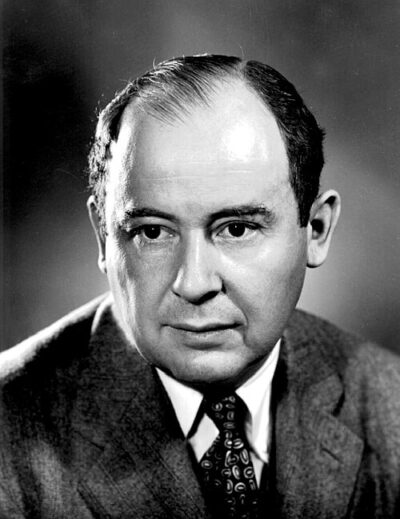
Von Neumann algebras were originally introduced by John von Neumann, motivated by his study of single operators, group representations, ergodic theory and quantum mechanics. His double commutant theorem shows that the analytic definition is equivalent to a purely algebraic definition as an algebra of symmetries.
Two basic examples of von Neumann algebras are as follows:The ring L∞(ℝ) of essentially bounded measurable functions on the real line is a commutative von Neumann algebra, whose elements act as multiplication operators by pointwise multiplication on the Hilbert space L2(ℝ) of square-integrable functions.
The algebra ℬ(ℋ) of all bounded operators on a Hilbert space ℋ is a von Neumann algebra, non-commutative if the Hilbert space has dimension at least 2.
Von Neumann algebras were first studied by von Neumann (1930) in 1929; he and Francis Murray developed the basic theory, under the original name of rings of operators, in a series of papers written in the 1930s and 1940s (F.J. Murray & J. von Neumann 1936, 1937, 1943; J. von Neumann 1938, 1940, 1943, 1949), reprinted in the collected works of von Neumann (1961).
Introductory accounts of von Neumann algebras are given in the online notes of Jones (2003) and Wassermann (1991) and the books by Dixmier (1981), Schwartz (1967), Blackadar (2005) and Sakai (1971). The three volume work by Takesaki (1979) gives an encyclopedic account of the theory. The book by Connes (1994) discusses more advanced topics.
From the Wikipedia article “Von Neumann algebra” (en.wikipedia.org/wiki/Von_Neumann_algebra), by its contributors, under CC BY-SA 4.0 (creativecommons.org/licenses/by-sa/4.0/). Copied 2026-11-16; not changed.
Confirmed Two sources agree. Cited One source, and it names where it got it. One source One source, without a reference of its own. Sources disagree The sources disagree. We show the best-supported value and keep theirs below.