
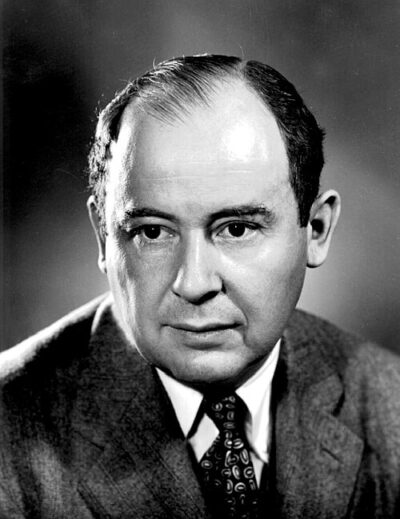
John von Neumann
John von Neumann was a Hungarian and American mathematician and physicist. Born December 28, 1903, in Budapest. Died February 8, 1957, in Washington, D.C.. Positions held include chairperson (1951–1952). Known for von Neumann cellular automaton, Von Neumann neighborhood and von Neumann universal constructor. Educated at Fasori Gimnázium and Frederick William University Berlin. Awards include Medal of Freedom, Carl-Gustaf Rossby Research Medal and Bôcher Memorial Prize.
Facts
75 facts · 2 confirmed by two sources · 45 cited · 28 from one source
Where this comes from
Papalocal keeps its own record. It started from these sources; what each one said is kept here as it was copied, so a change on their side never changes this page by itself. Tap one to read its version.
What Wikidata says · copied November 13, 2026 · revision 2568761152
- Described as
- Hungarian and American mathematician and physicist (1903–1957)
- Other names
- John Louis von Neumann, John Von Neumann, von Neumann, Neumann János Lajos, János Lajos Neumann, Janos Lajos Neumann, János Neumann
- Born
- December 28, 1903 · 11 references
- Died
- February 8, 1957 · 11 references
- Born in
- Budapest · 2 references
- Died in
- Washington, D.C. · 6 references
- Buried in
- Princeton Cemetery · 2 references
- Cause of death
- brain cancer · 1 reference
- Name at birth
- Neumann János Lajos
- Citizen of
- Hungary; United States (1937–) · 1 reference
- Occupation
- mathematician · 2 references; computer scientist · 1 reference; physicist; economist; university teacher · 1 reference; consultant; Manhattan Project (1941–1945); chemical engineer · 1 reference
- Positions held
- chairperson (1951–1952) · 1 reference
- Worked for
- Princeton University (1930–1933) · 1 reference; Frederick William University Berlin (1926–1929) · 1 reference; United States Atomic Energy Commission (1955–1957) · 1 reference; University of Hamburg (1929–1930) · 1 reference; Institute for Advanced Study (1933–1957) · 1 reference; Armed Forces Special Weapons Project (1950–1955) · 1 reference; Ballistic Research Laboratory (1940–1941) · 1 reference; Naval Ordnance Laboratory (1941–1955) · 1 reference
- Education
- Fasori Gimnázium (1911–1921) · 1 reference; Frederick William University Berlin (1921–1923) · 1 reference; ETH Zurich (1923–1925); Eötvös Loránd University (1926) · 1 reference; University of Göttingen (1926–1927) · 1 reference
- Member of
- National Academy of Sciences (1937–) · 1 reference; American Academy of Arts and Sciences (1944–) · 1 reference; American Philosophical Society · 1 reference; Royal Netherlands Academy of Arts and Sciences (1950–) · 1 reference; London Mathematical Society (1952–) · 1 reference; Institute of Mathematical Statistics (1945–) · 1 reference; Econometric Society (1947–) · 1 reference; United States Atomic Energy Commission (1953–1957) · 1 reference; Accademia Nazionale dei Lincei (1956–) · 1 reference
- Known for
- von Neumann cellular automaton; Von Neumann neighborhood; von Neumann universal constructor; von Neumann architecture; von Neumann algebra; von Neumann–Morgenstern utility theorem; von Neumann regular ring; Von Neumann–Bernays–Gödel set theory; von Neumann universe; von Neumann conjecture
- Awards
- Medal of Freedom (1956) · 2 references; Carl-Gustaf Rossby Research Medal (1956); Bôcher Memorial Prize (1938) · 2 references; Enrico Fermi Award (1956) · 1 reference; Josiah Willard Gibbs Lectureship (1947) · 1 reference; Silliman Memorial Lectures (1955); Medal for Merit (1947) · 1 reference; Albert Einstein Award (1956) · 1 reference; Financial Times Person of the Year (1999); Fellow of the Institute of Mathematical Statistics (1945) · 1 reference; Fellow of the Econometric Society (1947) · 1 reference
- Field
- functional analysis · 1 reference; operator theory; mathematics · 1 reference; physics · 1 reference; game theory · 1 reference; cellular automaton · 1 reference
- Spouse
- Klara Dan von Neumann (1938–1957) · 1 reference; Mariette Kövesi (1930–1936) · 1 reference
- Children
- Marina von Neumann Whitman
- Father
- Max von Neumann
- Mother
- Margaret Neumann
- Religion
- Judaism (–1930); Christianity (1930–)
- Nickname
- Good Time Johnny · 1 reference
- Wikipedias with a page
- 122
Wikidata item Q17455 (wikidata.org/wiki/Q17455), public domain (CC0). Copied November 13, 2026.
What Wikipedia says · copied November 13, 2026 · revision 1384365424
John von Neumann ( von NOY-mən; Hungarian: Neumann János Lajos; December 28, 1903 – February 8, 1957) was a Hungarian and American mathematician, physicist, computer scientist and engineer. Von Neumann had perhaps the widest breadth of any mathematician of his time, integrating pure and applied sciences and making major contributions to many fields, including mathematics, physics, economics, computing, and statistics. He was a pioneer in building the mathematical framework of quantum physics, in the development of functional analysis, and in game theory, introducing or codifying concepts including cellular automata, the universal constructor and the digital computer. His analysis of the structure of self-replication preceded the discovery of the structure of DNA.
During World War II, von Neumann worked on the Manhattan Project. He developed the mathematical models behind the explosive lenses used in the implosion-type nuclear weapon. Before and after the war, he consulted for many organizations including the Office of Scientific Research and Development, the United States Army's Ballistic Research Laboratory, the Armed Forces Special Weapons Project and the Oak Ridge National Laboratory. At the peak of his influence in the 1950s, he chaired a number of Defense Department committees including the Strategic Missile Evaluation Committee and the ICBM Scientific Advisory Committee. He was also a member of the influential Atomic Energy Commission in charge of all atomic energy development in the country. He played a key role alongside Bernard Schriever and Trevor Gardner in the design and development of the United States' first intercontinental ballistic missile (ICBM) programs. At that time he was considered the nation's foremost expert on nuclear weaponry and the leading defense scientist at the U.S. Department of Defense.
Von Neumann's contributions and intellectual ability drew praise from colleagues in physics, mathematics, and beyond. His accolades include a Medal of Freedom and a crater on the Moon named in his honor.
- Born, in its opening lines
- December 28, 1903
- Died, in its opening lines
- February 8, 1957
From the Wikipedia article “John von Neumann” (en.wikipedia.org/wiki/John_von_Neumann), by its contributors, under CC BY-SA 4.0 (creativecommons.org/licenses/by-sa/4.0/). Copied November 13, 2026; not changed.
Confirmed Two sources agree. Cited One source, and it names where it got it. One source One source, without a reference of its own. Sources disagree The sources disagree. We show the best-supported value and keep theirs below.
