Von Neumann neighborhood
Von Neumann neighborhood is an in cellular automata.
All 2 facts, and where they come from
Facts
2 facts · 0 confirmed by two sources · 0 cited · 2 from one source
Where this comes from
Papalocal keeps its own record. It started from these sources; what each one said is kept here as it was copied, so a change on their side never changes this page by itself. Tap one to read its version.
What Wikidata says · copied November 16, 2026 · revision 2426607272
- Described as
- in cellular automata
- Other names
- 4-neighborhood
- What it is
- computer algebra system
- Named after
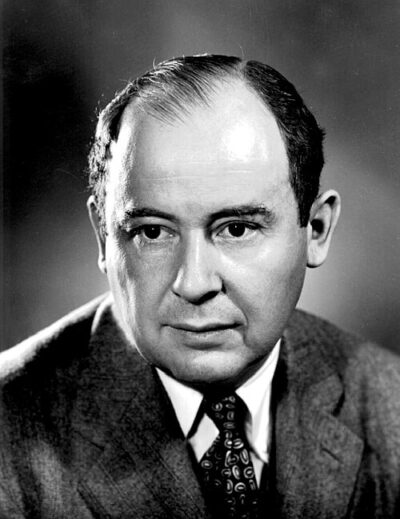
- John von Neumann
- Wikipedias with a page
- 10
Wikidata item Q1554323 (wikidata.org/wiki/Q1554323), public domain (CC0). Copied 2026-11-16.
What Wikipedia says · copied November 16, 2026 · revision 975036493
In cellular automata, the von Neumann neighborhood (or 4-neighborhood) is classically defined on a two-dimensional square lattice and is composed of a central cell and its four adjacent cells. The neighborhood is named after John von Neumann, who used it to define the von Neumann cellular automaton and the von Neumann universal constructor within it. It is one of the two most commonly used neighborhood types for two-dimensional cellular automata, the other one being the Moore neighborhood.
This neighbourhood can be used to define the notion of 4-connected pixels in computer graphics.
The von Neumann neighbourhood of a cell is the cell itself and the cells at a Manhattan distance of 1.
The concept can be extended to higher dimensions, for example forming a 6-cell octahedral neighborhood for a cubic cellular automaton in three dimensions.
From the Wikipedia article “Von Neumann neighborhood” (en.wikipedia.org/wiki/Von_Neumann_neighborhood), by its contributors, under CC BY-SA 4.0 (creativecommons.org/licenses/by-sa/4.0/). Copied 2026-11-16; not changed.
Confirmed Two sources agree. Cited One source, and it names where it got it. One source One source, without a reference of its own. Sources disagree The sources disagree. We show the best-supported value and keep theirs below.