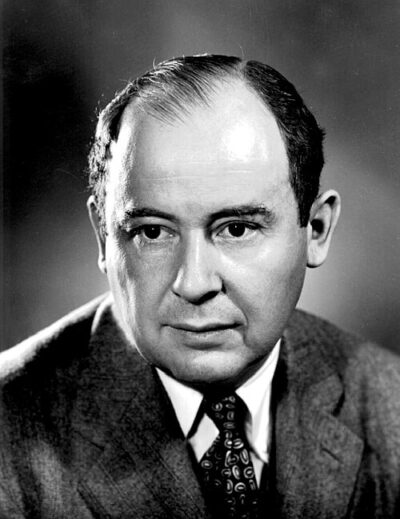
von Neumann universe
Von Neumann universe is an in set theory, the collection of sets obtained by transfinite recursion using the powerset operation.
All 3 facts, and where they come from
Facts
3 facts · 0 confirmed by two sources · 0 cited · 3 from one source
Where this comes from
Papalocal keeps its own record. It started from these sources; what each one said is kept here as it was copied, so a change on their side never changes this page by itself. Tap one to read its version.
What Wikidata says · copied November 16, 2026 · revision 2555787395
- Described as
- in set theory, the collection of sets obtained by transfinite recursion using the powerset operation
- Other names
- cumulative hierarchy, von Neumann hierarchy of sets, von Neumann hierarchy, V
- What it is
- proper class; cumulative hierarchy
- Named after
- John von Neumann
- Wikipedias with a page
- 12
Wikidata item Q77887 (wikidata.org/wiki/Q77887), public domain (CC0). Copied 2026-11-16.
What Wikipedia says · copied November 16, 2026 · revision 1383142412
In set theory and related branches of mathematics, the von Neumann universe, or von Neumann hierarchy of sets, denoted by V, is the class of hereditary well-founded sets. This collection, which is formalized by Zermelo–Fraenkel set theory (ZFC), is often used to provide an interpretation or motivation of the axioms of ZFC. The concept is named after John von Neumann, although it was first published by Ernst Zermelo in 1930.
The rank of a well-founded set is defined inductively as the smallest ordinal number greater than the ranks of all members of the set. In particular, the rank of the empty set is zero, and every ordinal has a rank equal to itself. The sets in V are divided into the transfinite hierarchy Vα , called the cumulative hierarchy, based on their rank.
From the Wikipedia article “Von Neumann universe” (en.wikipedia.org/wiki/Von_Neumann_universe), by its contributors, under CC BY-SA 4.0 (creativecommons.org/licenses/by-sa/4.0/). Copied 2026-11-16; not changed.
Confirmed Two sources agree. Cited One source, and it names where it got it. One source One source, without a reference of its own. Sources disagree The sources disagree. We show the best-supported value and keep theirs below.