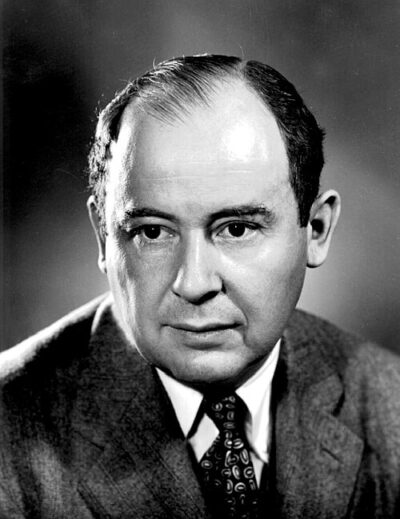
von Neumann cellular automaton
Von Neumann cellular automaton is a cellular automaton used to model universal construction.
All 3 facts, and where they come from
Facts
3 facts · 0 confirmed by two sources · 0 cited · 3 from one source
Where this comes from
Papalocal keeps its own record. It started from these sources; what each one said is kept here as it was copied, so a change on their side never changes this page by itself. Tap one to read its version.
What Wikidata says · copied November 16, 2026 · revision 2079063023
- Described as
- cellular automaton used to model universal construction
- What it is
- cellular automaton; computer algebra system
- Named after
- John von Neumann
- Wikipedias with a page
- 5
Wikidata item Q4056286 (wikidata.org/wiki/Q4056286), public domain (CC0). Copied 2026-11-16.
What Wikipedia says · copied November 16, 2026 · revision 1381767559
Von Neumann cellular automata are the original expression of cellular automata, the development of which was prompted by suggestions made to John von Neumann by his close friend and fellow mathematician Stanisław Ulam. Their original purpose was to provide insight into the logical requirements for machine self-replication, and they were used in von Neumann's universal constructor.
Nobili cellular automaton is a variation of von Neumann's cellular automaton, augmented with the ability for confluent cells to cross signals and store information. The former requires an extra three states, hence Nobili's cellular automaton has 32 states, rather than 29. Hutton's cellular automaton is yet another variation, which allows a loop of data, analogous to Langton's loops, to replicate.
From the Wikipedia article “Von Neumann cellular automaton” (en.wikipedia.org/wiki/Von_Neumann_cellular_automaton), by its contributors, under CC BY-SA 4.0 (creativecommons.org/licenses/by-sa/4.0/). Copied 2026-11-16; not changed.
Confirmed Two sources agree. Cited One source, and it names where it got it. One source One source, without a reference of its own. Sources disagree The sources disagree. We show the best-supported value and keep theirs below.