When Will You Marry?
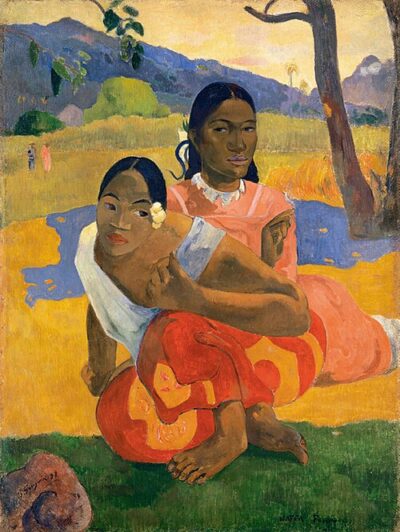
When Will You Marry? is a 1892 Paul Gauguin painting.
- Came out
- 1892
- Created by
- Paul Gauguin
- Genre
- genre art
All 8 facts, and where they come from
Facts
8 facts · 0 confirmed by two sources · 0 cited · 8 from one source
Where this comes from
Papalocal keeps its own record. It started from these sources; what each one said is kept here as it was copied, so a change on their side never changes this page by itself. Tap one to read its version.
What Wikidata says · copied November 17, 2026 · revision 2568677595
- Described as
- 1892 Paul Gauguin painting
- Other names
- Nafea faa ipoipo?
- What it is
- painting
- Created by
- Paul Gauguin
- Genre
- genre art; portrait; figure painting
- Came out
- 1892
- Owned by
- Princess Al Mayassa bint Hamad of Qatar (2015–); Rudolf Staechelin (1917–2015)
- Wikipedias with a page
- 31
Wikidata item Q3869871 (wikidata.org/wiki/Q3869871), public domain (CC0). Copied 2026-11-17.
What Wikipedia says · copied November 17, 2026 · revision 1383258404
When Will You Marry? (French: Quand te maries-tu ?, Tahitian: Nafea faa ipoipo?) is an oil painting from 1892 by the French Post-Impressionist artist Paul Gauguin. On loan to the Kunstmuseum in Basel, Switzerland for nearly a half-century, it was sold privately by the family of Rudolf Staechelin to Sheikha Al-Mayassa bint Hamad Al-Thani, in February 2015 for close to US$210 million (£155 million), one of the highest prices ever paid for a work of art. The painting was on exhibition at the Fondation Beyeler, Riehen, until 28 June 2015.
From the Wikipedia article “When Will You Marry?” (en.wikipedia.org/wiki/When_Will_You_Marry?), by its contributors, under CC BY-SA 4.0 (creativecommons.org/licenses/by-sa/4.0/). Copied 2026-11-17; not changed.
Confirmed Two sources agree. Cited One source, and it names where it got it. One source One source, without a reference of its own. Sources disagree The sources disagree. We show the best-supported value and keep theirs below.
Picture: Paul Gauguin, via Wikimedia Commons · Public domain