Wien's displacement law
Wien's displacement law is a relation between the wavelength of the black-body radiation curve peak and the temperature.
All 2 facts, and where they come from
Facts
2 facts · 0 confirmed by two sources · 0 cited · 2 from one source
Where this comes from
Papalocal keeps its own record. It started from these sources; what each one said is kept here as it was copied, so a change on their side never changes this page by itself. Tap one to read its version.
What Wikidata says · copied November 17, 2026 · revision 2545352547
- Described as
- relation between the wavelength of the black-body radiation curve peak and the temperature
- What it is
- physical law
- Named after
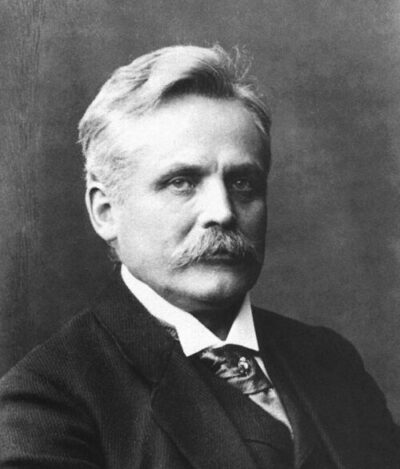
- Wilhelm Wien
- Wikipedias with a page
- 49
Wikidata item Q214336 (wikidata.org/wiki/Q214336), public domain (CC0). Copied 2026-11-17.
What Wikipedia says · copied November 17, 2026 · revision 1372181459
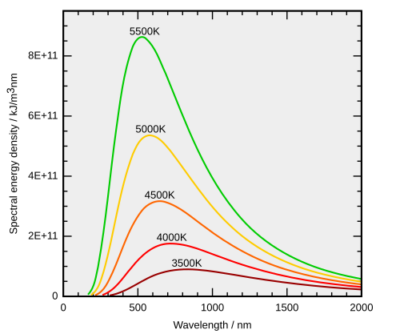
In physics, Wien's displacement law states that the black-body radiation curve for different temperatures will peak at different wavelengths that are inversely proportional to the temperature. The shift of that peak is a direct consequence of the Planck radiation law, which describes the spectral brightness or intensity of black-body radiation as a function of wavelength at any given temperature. However, it had been discovered by German physicist Wilhelm Wien several years before Max Planck developed that more general equation, and describes the entire shift of the spectrum of black-body radiation toward shorter wavelengths as temperature increases.
Formally, the wavelength version of Wien's displacement law states that the spectral radiance of black-body radiation per unit wavelength, peaks at the wavelength λpeak given by:
λpeak=bT
where T is the absolute temperature and b is a constant of proportionality called Wien's displacement constant, equal to 2.897771955...×10−3 m⋅K, or b ≈ 2898 μm⋅K.
This is an inverse relationship between wavelength and temperature. So the higher the temperature, the shorter or smaller the wavelength of the thermal radiation. The lower the temperature, the longer or larger the wavelength of the thermal radiation. For visible radiation, hot objects emit bluer light than cool objects. If one is considering the peak of black body emission per unit frequency or per proportional bandwidth, one must use a different proportionality constant. However, the form of the law remains the same: the peak wavelength is inversely proportional to temperature, and the peak frequency is directly proportional to temperature.
There are other formulations of Wien's displacement law, which are parameterized relative to other quantities. For these alternate formulations, the form of the relationship is similar, but the proportionality constant, b, differs.
Wien's displacement law may be referred to as "Wien's law", a term which is also used for the Wien approximation.
In "Wien's displacement law", the word displacement refers to how the intensity-wavelength graphs appear shifted (displaced) for different temperatures.
From the Wikipedia article “Wien's displacement law” (en.wikipedia.org/wiki/Wien's_displacement_law), by its contributors, under CC BY-SA 4.0 (creativecommons.org/licenses/by-sa/4.0/). Copied 2026-11-17; not changed.
Confirmed Two sources agree. Cited One source, and it names where it got it. One source One source, without a reference of its own. Sources disagree The sources disagree. We show the best-supported value and keep theirs below.
Picture: 4C, via Wikimedia Commons · CC BY-SA 3.0