
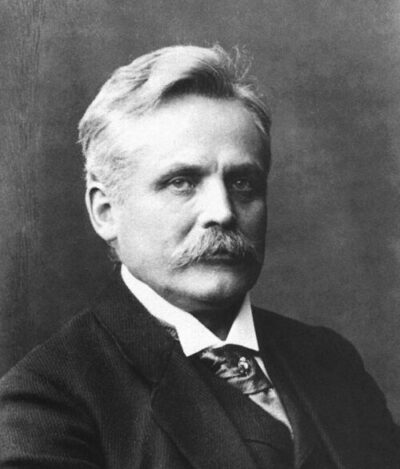
Wilhelm Wien
Wilhelm Wien was a German physicist. Born January 13, 1864, in Parusnoye. Died August 30, 1928, in Munich. Positions held include rector (1925–1926), co-editor (1906–1928) and chairperson (1920–1922). Known for mass spectrometer, Wien's displacement law and Wien approximation. Educated at University of Göttingen and Frederick William University Berlin (2 times). Awards include Nobel Prize in Physics, Bavarian Maximilian Order for Science and Art and Guthrie Lecture.
Facts
38 facts · 2 confirmed by two sources · 19 cited · 17 from one source
Where this comes from
Papalocal keeps its own record. It started from these sources; what each one said is kept here as it was copied, so a change on their side never changes this page by itself. Tap one to read its version.
What Wikidata says · copied November 16, 2026 · revision 2568760763
- Described as
- German physicist (1864-1928)
- Other names
- Wilhelm Carl Werner Otto Fritz Franz Wien
- Born
- January 13, 1864 · 9 references
- Died
- August 30, 1928 · 9 references
- Born in
- Parusnoye · 1 reference
- Died in
- Munich · 3 references
- Buried in
- Munich Waldfriedhof · 2 references
- Name at birth
- Wilhelm Carl Werner Otto Fritz Franz Wien · 1 reference
- Citizen of
- Germany
- Occupation
- physicist · 1 reference; university teacher; theoretical physicist
- Positions held
- rector (1925–1926); co-editor (1906–1928) · 2 references; chairperson (1920–1922) · 1 reference
- Worked for
- LMU Munich (1920–1926) · 1 reference; University of Würzburg (1900–1920) · 1 reference; University of Giessen (1899–1900) · 1 reference; RWTH Aachen University (1896–1899) · 1 reference; Frederick William University Berlin (1892–1896) · 1 reference
- Education
- University of Göttingen (1882–1883) · 1 reference; Frederick William University Berlin (2 times) (1883–1892) · 1 reference; Altstadt Gymnasium (–1882) · 1 reference
- Member of
- Royal Swedish Academy of Sciences; Royal Prussian Academy of Sciences; Bavarian Academy of Sciences and Humanities; Göttingen Academy of Sciences and Humanities in Lower Saxony
- Known for
- mass spectrometer; Wien's displacement law; Wien approximation
- Awards
- Nobel Prize in Physics (1911) · 2 references; Bavarian Maximilian Order for Science and Art (1925); Guthrie Lecture (1925) · 1 reference; honorary member of the Physics Association (Frankfurt am Main, Germany) (1901)
- Field
- physics · 1 reference; radiation · 1 reference; heat · 1 reference
- Spouse
- Luise Mehler · 1 reference
- Children
- Karl Wien
- Lived in
- Germany · 1 reference
- Wikipedias with a page
- 96
Wikidata item Q57068 (wikidata.org/wiki/Q57068), public domain (CC0). Copied November 16, 2026.
What Wikipedia says · copied November 16, 2026 · revision 1381544793
Wilhelm Carl Werner Otto Fritz Franz Wien (German: [ˈvɪlhɛlm ˈviːn] ; 13 January 1864 – 30 August 1928) was a German physicist who used theories about heat and electromagnetism to deduce Wien's displacement law, which calculates the emission of a blackbody at any temperature from the emission at any one reference temperature.
Wien also formulated an expression for the black-body radiation, which is correct in the photon-gas limit. His arguments were based on the notion of adiabatic invariance, and were instrumental for the formulation of quantum mechanics. Wien received the Nobel Prize in Physics in 1911 for his work on heat radiation.
He was a cousin of Max Wien, inventor of the Wien bridge.
- Born, in its opening lines
- January 13, 1864
- Died, in its opening lines
- August 30, 1928
From the Wikipedia article “Wilhelm Wien” (en.wikipedia.org/wiki/Wilhelm_Wien), by its contributors, under CC BY-SA 4.0 (creativecommons.org/licenses/by-sa/4.0/). Copied November 16, 2026; not changed.
Confirmed Two sources agree. Cited One source, and it names where it got it. One source One source, without a reference of its own. Sources disagree The sources disagree. We show the best-supported value and keep theirs below.
