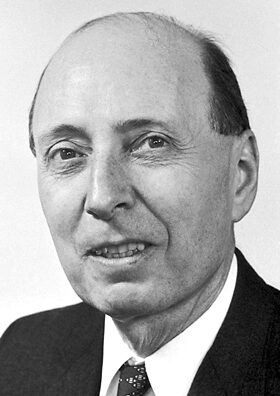
Wigner's theorem
Wigner's theorem is a theorem in the mathematical formulation of quantum mechanics.
All 2 facts, and where they come from
Facts
2 facts · 0 confirmed by two sources · 0 cited · 2 from one source
Where this comes from
Papalocal keeps its own record. It started from these sources; what each one said is kept here as it was copied, so a change on their side never changes this page by itself. Tap one to read its version.
What Wikidata says · copied November 16, 2026 · revision 2398125838
- Described as
- theorem in the mathematical formulation of quantum mechanics
- Other names
- Ray space, Ray product
- What it is
- theorem
- Named after
- Eugene Paul Wigner
- Wikipedias with a page
- 10
Wikidata item Q1135224 (wikidata.org/wiki/Q1135224), public domain (CC0). Copied 2026-11-16.
What Wikipedia says · copied November 16, 2026 · revision 1368592380
Wigner's theorem, proved by Eugene Wigner in 1931, is a cornerstone of the mathematical formulation of quantum mechanics. The theorem specifies how physical symmetries such as rotations, translations, and CPT transformations are represented on the Hilbert space of states.
The physical states in a quantum theory are represented by unit vectors in Hilbert space up to a phase factor, i.e. by the complex line or ray the vector spans. In addition, by the Born rule the absolute value of the unit vector's inner product with a unit eigenvector, or equivalently the cosine squared of the angle between the lines the vectors span, corresponds to the transition probability. Ray space, in mathematics known as projective Hilbert space, is the space of all unit vectors in Hilbert space up to the equivalence relation of differing by a phase factor. By Wigner's theorem, any transformation of ray space that preserves the absolute value of the inner products can be represented by a unitary or antiunitary transformation of Hilbert space, which is unique up to a phase factor. As a consequence, the representation of a symmetry group on ray space can be lifted to a projective representation or sometimes even an ordinary representation on Hilbert space.
From the Wikipedia article “Wigner's theorem” (en.wikipedia.org/wiki/Wigner's_theorem), by its contributors, under CC BY-SA 4.0 (creativecommons.org/licenses/by-sa/4.0/). Copied 2026-11-16; not changed.
Confirmed Two sources agree. Cited One source, and it names where it got it. One source One source, without a reference of its own. Sources disagree The sources disagree. We show the best-supported value and keep theirs below.