
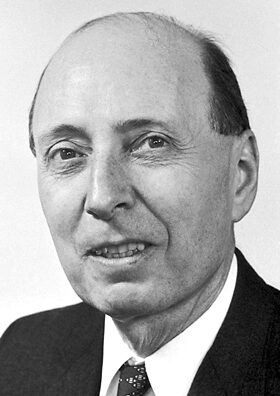
Eugene Paul Wigner
Eugene Paul Wigner was a Hungarian-American physicist and mathematician. Born November 17, 1902, in Budapest. Died January 1, 1995, in Princeton. Known for The Unreasonable Effectiveness of Mathematics in the Natural Sciences and Wigner's theorem. Educated at Fasori Gimnázium and Technische Universität Berlin. Awards include Nobel Prize in Physics, Max Planck Medal and Enrico Fermi Award.
Facts
53 facts · 2 confirmed by two sources · 30 cited · 21 from one source
Where this comes from
Papalocal keeps its own record. It started from these sources; what each one said is kept here as it was copied, so a change on their side never changes this page by itself. Tap one to read its version.
What Wikidata says · copied November 13, 2026 · revision 2568211081
- Described as
- Hungarian-American physicist and mathematician (1902–1995)
- Other names
- Eugene P. Wigner, Eugene Wigner
- Born
- November 17, 1902 · 13 references
- Died
- January 1, 1995 · 10 references
- Born in
- Budapest · 1 reference
- Died in
- Princeton · 2 references
- Buried in
- Princeton Cemetery · 2 references
- Cause of death
- pneumonia · 1 reference
- Citizen of
- Hungary; United States · 2 references
- Occupation
- mathematician; physicist · 1 reference; university teacher · 1 reference; theoretical physicist; nuclear physicist
- Worked for
- Princeton University (3 times) (1930–1971) · 1 reference; Technische Universität Berlin (1928–1933) · 1 reference; University of Wisconsin–Madison (1936–1938) · 1 reference; University of Göttingen (1927–1928) · 2 references; Leiden University (1956–1957) · 1 reference; Manhattan Project (1942–1945) · 1 reference; Oak Ridge National Laboratory (1945–1946) · 1 reference
- Education
- Fasori Gimnázium (–1919) · 1 reference; Technische Universität Berlin (1920–1925) · 1 reference
- Member of
- Royal Society of London; Hungarian Academy of Sciences; American Academy of Arts and Sciences; American Philosophical Society (1944–) · 1 reference; American Association for the Advancement of Science · 1 reference; American Physical Society · 1 reference; Royal Netherlands Academy of Arts and Sciences · 1 reference; National Academy of Sciences (1945–); Göttingen Academy of Sciences and Humanities in Lower Saxony
- Known for
- The Unreasonable Effectiveness of Mathematics in the Natural Sciences; Wigner's theorem
- Awards
- Nobel Prize in Physics (1963) · 2 references; Max Planck Medal (1961) · 1 reference; Enrico Fermi Award (1958) · 1 reference; Albert Einstein Award (1972); National Medal of Science (1969) · 1 reference; Wigner Medal (1978); Josiah Willard Gibbs Lectureship (1968) · 1 reference; Franklin Medal (1950) · 1 reference; Richtmyer Memorial Lecture Award (1955); Fellow of the American Physical Society; Foreign Member of the Royal Society (1970) · 1 reference; John von Neumann Prize (1966) · 2 references; Medal for Merit (1946) · 1 reference; Atoms for Peace Award (1960) · 1 reference
- Field
- physics
- Spouse
- Amelia Frank · 1 reference; Mary Annette Wheeler; Eileen Clare-Patton Hamilton
- Children
- David Wheeler Wigner
- Siblings
- Margit Dirac
- Wikipedias with a page
- 98
Wikidata item Q155790 (wikidata.org/wiki/Q155790), public domain (CC0). Copied November 13, 2026.
What Wikipedia says · copied November 13, 2026 · revision 1385346559
Eugene Paul Wigner (Hungarian: Wigner Jenő Pál, pronounced [ˈviɡnɛr ˈjɛnøː ˈpaːl]; November 17, 1902 – January 1, 1995) was a Hungarian-American theoretical physicist and chemical engineer who contributed to mathematical physics. He received the Nobel Prize in Physics in 1963 "for his contributions to the theory of the atomic nucleus and the elementary particles, particularly through the discovery and application of fundamental symmetry principles".
A graduate of the Technical Hochschule Berlin (now Technische Universität Berlin), Wigner worked as an assistant to Karl Weissenberg and Richard Becker at the Kaiser Wilhelm Institute in Berlin, and David Hilbert at the University of Göttingen. Wigner and Hermann Weyl were responsible for introducing group theory into physics, particularly the theory of symmetry in physics. Along the way he performed ground-breaking work in pure mathematics, in which he authored a number of mathematical theorems. In particular, Wigner's theorem is a cornerstone in the mathematical formulation of quantum mechanics. He is also known for his research into the structure of the atomic nucleus. In 1930, Princeton University recruited Wigner, along with John von Neumann, and he moved to the United States, where he obtained citizenship in 1937.
Wigner participated in a meeting with Leo Szilard and Albert Einstein that resulted in the Einstein–Szilard letter, which prompted President Franklin D. Roosevelt to authorize the creation of the Advisory Committee on Uranium with the purpose of investigating the feasibility of nuclear weapons. Wigner was afraid that the German nuclear weapon project would develop an atomic bomb first. During the Manhattan Project, he led a team whose task was to design nuclear reactors to convert uranium into weapons grade plutonium. At the time, reactors existed only on paper, and no reactor had yet gone critical. Wigner was disappointed that DuPont was given responsibility for the detailed design of the reactors, not just their construction. He became director of research and development at the Clinton Laboratory (now the Oak Ridge National Laboratory) in early 1946, but became frustrated with bureaucratic interference by the Atomic Energy Commission, and returned to Princeton.
In the postwar period, he served on government bodies, including the National Bureau of Standards from 1947 to 1951, the mathematics panel of the National Research Council from 1951 to 1954, the physics panel of the National Science Foundation, and the influential General Advisory Committee of the Atomic Energy Commission from 1952 to 1957 and again from 1959 to 1964. In later life, he became more philosophical, and published "The Unreasonable Effectiveness of Mathematics in the Natural Sciences", his best-known work outside technical mathematics and physics.
- Born, in its opening lines
- November 17, 1902
- Died, in its opening lines
- January 1, 1995
From the Wikipedia article “Eugene Wigner” (en.wikipedia.org/wiki/Eugene_Wigner), by its contributors, under CC BY-SA 4.0 (creativecommons.org/licenses/by-sa/4.0/). Copied November 13, 2026; not changed.
Confirmed Two sources agree. Cited One source, and it names where it got it. One source One source, without a reference of its own. Sources disagree The sources disagree. We show the best-supported value and keep theirs below.
