Yukawa potential
Yukawa potential is a screened Coulomb potential that exponentially decays.
All 1 facts, and where they come from
Facts
1 facts · 0 confirmed by two sources · 0 cited · 1 from one source
Where this comes from
Papalocal keeps its own record. It started from these sources; what each one said is kept here as it was copied, so a change on their side never changes this page by itself. Tap one to read its version.
What Wikidata says · copied November 17, 2026 · revision 2290678200
- Described as
- screened Coulomb potential that exponentially decays
- Named after
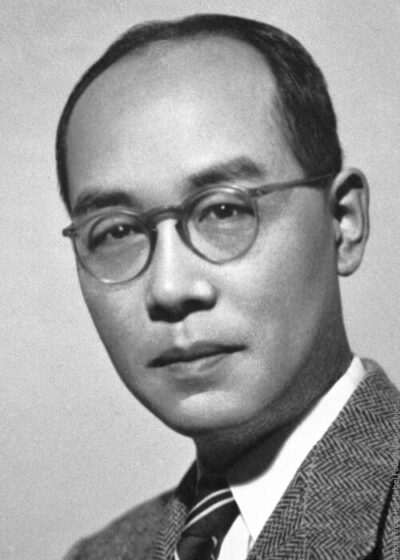
- Hideki Yukawa
- Wikipedias with a page
- 24
Wikidata item Q1153833 (wikidata.org/wiki/Q1153833), public domain (CC0). Copied 2026-11-17.
What Wikipedia says · copied November 17, 2026 · revision 1371658231
In particle, atomic and condensed matter physics, a Yukawa potential (also called a screened Coulomb potential) is a potential named after the Japanese physicist Hideki Yukawa. The potential is of the form:
VYukawa(r)=−g2e−αmrr,
where g is a magnitude scaling constant, i.e. is the amplitude of potential, m is the mass of the particle, r is the radial distance to the particle, and α is another scaling constant, so that r≈1αm is the approximate range. The potential is monotonically increasing in r and it is negative, implying the force is attractive. In the SI system, the unit of the Yukawa potential is the inverse meter.
The Coulomb potential of electromagnetism is an example of a Yukawa potential with the e−αmr factor equal to 1, everywhere. This can be interpreted as saying that the photon mass m is equal to 0. The photon is the force-carrier between interacting, charged particles.
In interactions between a meson field and a fermion field, the constant g is equal to the gauge coupling constant between those fields. In the case of the nuclear force, the fermions would be a proton and another proton or a neutron.
From the Wikipedia article “Yukawa potential” (en.wikipedia.org/wiki/Yukawa_potential), by its contributors, under CC BY-SA 4.0 (creativecommons.org/licenses/by-sa/4.0/). Copied 2026-11-17; not changed.
Confirmed Two sources agree. Cited One source, and it names where it got it. One source One source, without a reference of its own. Sources disagree The sources disagree. We show the best-supported value and keep theirs below.