
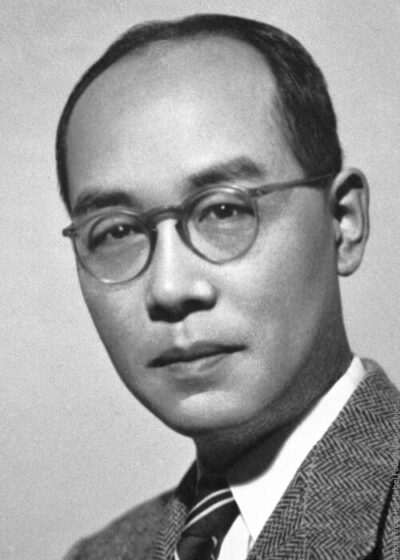
Hideki Yukawa
Hideki Yukawa was a Japanese theoretical physicist. Born January 23, 1907, in Azabu. Died September 8, 1981, in Kyoto. Known for pion, Yukawa potential and Yukawa interaction. Educated at Kyoto University and University of Osaka. Awards include Imperial Prize of Japan Academy, Order of Culture and Nobel Prize in Physics.
Facts
46 facts · 2 confirmed by two sources · 17 cited · 27 from one source
Where this comes from
Papalocal keeps its own record. It started from these sources; what each one said is kept here as it was copied, so a change on their side never changes this page by itself. Tap one to read its version.
What Wikidata says · copied November 16, 2026 · revision 2565307735
- Described as
- Japanese theoretical physicist (1907-1981)
- Other names
- Yukawa Hideki
- Born
- January 23, 1907 · 6 references
- Died
- September 8, 1981 · 6 references
- Born in
- Azabu
- Died in
- Kyoto · 1 reference
- Buried in
- Chion-in Temple · 1 reference
- Citizen of
- Japan; Empire of Japan (–1947)
- Occupation
- physicist · 1 reference; theoretical physicist; nuclear physicist; university teacher
- Worked for
- University of Tokyo; Kyoto University; Columbia University; University of Osaka
- Education
- Kyoto University · 1 reference; University of Osaka · 2 references
- Member of
- Royal Society of London (1963–); Academy of Sciences of the USSR (1966–) · 1 reference; Japan Academy (1946–) · 1 reference; Pontifical Academy of Sciences (1961–) · 1 reference; Royal Society of Edinburgh; American Academy of Arts and Sciences (1961–) · 1 reference; National Academy of Sciences (1949–) · 1 reference; Indian National Science Academy; American Physical Society (1949–) · 2 references; American Philosophical Society (1963–)
- Known for
- pion; Yukawa potential; Yukawa interaction
- Awards
- Imperial Prize of Japan Academy (1940) · 1 reference; Order of Culture (1943); Nobel Prize in Physics (1949) · 2 references; Person of Cultural Merit (1951); Fellow of the Royal Society of Edinburgh (1955–) · 1 reference; doctor honoris causa from the University of Paris (1956) · 1 reference; Lomonosov Gold Medal (1963) · 1 reference; Foreign Member of the Royal Society (1963) · 1 reference; Order of the Rising Sun, 1st class; Pour le Mérite for Sciences and Arts order
- Field
- physics · 1 reference
- Spouse
- Sumi Yukawa (1932–)
- Father
- Takuji Ogawa
- Siblings
- Yoshiki Ogawa; Shigeki Kaizuka; Tamaki Ogawa
- Wikipedias with a page
- 94
Wikidata item Q155777 (wikidata.org/wiki/Q155777), public domain (CC0). Copied November 16, 2026.
What Wikipedia says · copied November 16, 2026 · revision 1384478891
Hideki Yukawa (湯川 秀樹, Yukawa Hideki; né Ogawa; 23 January 1907 – 8 September 1981) was a Japanese theoretical physicist who received the Nobel Prize in Physics in 1949 "for his prediction of the existence of mesons on the basis of theoretical work on nuclear forces."
- Born, in its opening lines
- January 23, 1907
- Died, in its opening lines
- September 8, 1981
From the Wikipedia article “Hideki Yukawa” (en.wikipedia.org/wiki/Hideki_Yukawa), by its contributors, under CC BY-SA 4.0 (creativecommons.org/licenses/by-sa/4.0/). Copied November 16, 2026; not changed.
Confirmed Two sources agree. Cited One source, and it names where it got it. One source One source, without a reference of its own. Sources disagree The sources disagree. We show the best-supported value and keep theirs below.
