
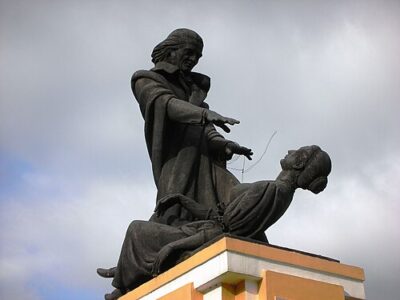
Abbé Faria
Abbé Faria was a Goan Catholic monk and pioneer of hypnotism. Born May 30, 1756, in Candolim. Died September 20, 1819, in Paris.
Facts
12 facts · 1 confirmed by two sources · 3 cited · 7 from one source · 1 where the sources disagree
What’s different
- Born: we show May 30, 1756 (Sources disagree). Wikipedia says May 31, 1756
Where this comes from
Papalocal keeps its own record. It started from these sources; what each one said is kept here as it was copied, so a change on their side never changes this page by itself. Tap one to read its version.
What Wikidata says · copied November 18, 2026 · revision 2567637724
- Described as
- Goan Catholic monk and pioneer of hypnotism
- Other names
- Abbe Faria, Abbe faria, José Custodio de Faria, Jose Custodio de Faria
- Born
- May 30, 1756
- Died
- September 20, 1819 · 1 reference
- Born in
- Candolim
- Died in
- Paris · 1 reference
- Citizen of
- Kingdom of Portugal
- Occupation
- scientist; monk; physician; hypnotist · 1 reference; Catholic priest · 1 reference
- Field
- hypnosis
- Religion
- Catholic Church
- Wikipedias with a page
- 20
Wikidata item Q306914 (wikidata.org/wiki/Q306914), public domain (CC0). Copied November 18, 2026.
What Wikipedia says · copied November 18, 2026 · revision 1368398422
Abbé Faria (Portuguese: Abade Faria) (born José Custódio de Faria; 31 May 1756 – 20 September 1819) was a Goan Catholic priest from Portuguese India who was one of the pioneers of the scientific study of hypnotism, following on from the work of Franz Mesmer. Unlike Mesmer, who claimed that hypnosis was mediated by "animal magnetism", Faria understood that it worked purely by the power of suggestion. In the early 19th century, Abbé Faria introduced oriental hypnosis to Paris.
Faria was one of the first to depart from the theory of the "magnetic fluid", to place in relief the importance of suggestion, and to demonstrate the existence of "autosuggestion"; he also established that what he termed nervous sleep belongs to the natural order. From his earliest magnetizing séances, in 1814, he boldly developed his doctrine. Nothing comes from the magnetizer; everything comes from the subject and takes place in his imagination generated from within the mind. Magnetism is only a form of sleep. Although of the moral order, the magnetic action is often aided by physical, or rather by physiological, means–fixedness of look and cerebral fatigue.
Faria changed the terminology of mesmerism. Previously, the focus was on the "concentration" of the subject. In Faria's terminology the operator became "the concentrator" and somnambulism was viewed as a lucid sleep. The method of hypnosis used by Faria is command, following expectancy. The theory of Abbé Faria is now known as Fariism. Later, Ambroise-Auguste Liébeault (1864–1904), the founder of the Nancy School, and Émile Coué (1857–1926), father of applied conditioning, developed the theory of suggestion and autosuggestion and began using them as therapeutic tools. Johannes Schultz developed these theories as Autogenic training.
- Born, in its opening lines
- May 31, 1756
- Died, in its opening lines
- September 20, 1819
From the Wikipedia article “Abbé Faria” (en.wikipedia.org/wiki/Abbé_Faria), by its contributors, under CC BY-SA 4.0 (creativecommons.org/licenses/by-sa/4.0/). Copied November 18, 2026; not changed.
Confirmed Two sources agree. Cited One source, and it names where it got it. One source One source, without a reference of its own. Sources disagree The sources disagree. We show the best-supported value and keep theirs below.
