
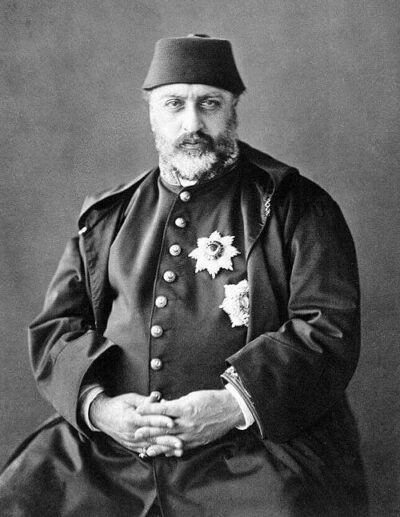
Abdülaziz
Abdülaziz was the 32th Sultan of the Ottoman Empire. Born February 8, 1830, in Beylerbeyi Palace. Died June 4, 1876, in Feriye Palace. Positions held include sultan of the Ottoman Empire (1861–1876). Awards include Knight of the Order of the Golden Fleece, Order of St. Andrew and Order of the Garter.
Facts
36 facts · 2 confirmed by two sources · 8 cited · 26 from one source
Where this comes from
Papalocal keeps its own record. It started from these sources; what each one said is kept here as it was copied, so a change on their side never changes this page by itself. Tap one to read its version.
What Wikidata says · copied November 16, 2026 · revision 2565582321
- Described as
- 32th Sultan of the Ottoman Empire (1861–1876)
- Other names
- Abdul-Aziz, Abdulaziz
- Born
- February 8, 1830 · 1 reference
- Died
- June 4, 1876 · 4 references
- Born in
- Beylerbeyi Palace
- Died in
- Feriye Palace
- Buried in
- Mausoleum of Mahmud II
- Citizen of
- Ottoman Empire · 1 reference
- Occupation
- ruler; composer · 1 reference; writer · 1 reference; sultan · 1 reference
- Positions held
- sultan of the Ottoman Empire (1861–1876) · 2 references
- Member of
- Ottoman dynasty · 1 reference
- Awards
- Knight of the Order of the Golden Fleece; Order of St. Andrew; Order of the Garter (1867); Order of the Wendish Crown (1871); Grand Cross of the Order of the Tower and Sword; Order of the Most Holy Annunciation
- Spouse
- Hayranıdil Kadın; Neşerek Kadın · 1 reference; Dürrinev Kadın · 1 reference; Edadil Kadın; Gevheri Kadın
- Children
- Abdülmecid II; Esma Sultan · 1 reference; Fatma Saliha Sultan · 1 reference; Nazime Sultan · 1 reference; Emine Sultan · 1 reference; Şehzade Yusuf Izzeddin · 1 reference; Şehzade Mehmed Şevket · 1 reference; Sehzade Mehmed Seyfeddin · 1 reference
- Father
- Mahmud II · 1 reference
- Mother
- Pertevniyal Sultan
- Siblings
- Adile Sultan; Abdülmecid I · 1 reference
- Religion
- Islam · 1 reference
- Wikipedias with a page
- 75
Wikidata item Q151500 (wikidata.org/wiki/Q151500), public domain (CC0). Copied November 16, 2026.
What Wikipedia says · copied November 16, 2026 · revision 1381994574
Abdulaziz (Ottoman Turkish: عبد العزيز, romanized: ʿAbdü'l-ʿAzîz; Turkish: Abdülaziz; 8 February 1830 – 4 June 1876) was the sultan of the Ottoman Empire from 25 June 1861 to 30 May 1876, when he was overthrown in a government coup. He was a son of Sultan Mahmud II and succeeded his brother Abdulmejid I in 1861.
Abdulaziz's reign began during the Ottoman Empire's resurgence following the Crimean War and two decades of the Tanzimat reforms, though it was now reliant on European capital. He was the first Ottoman sultan who traveled to Western Europe in a diplomatic capacity, visiting a number of important European capitals including Paris, London, and Vienna in the summer of 1867. The decade after his ascension was dominated by the duo of Fuad Pasha and Aali Pasha, who accelerated reorganization of the Empire. The Vilayet Law was promulgated, Western codes were applied to more aspects of Ottoman law, and the millets were restructured. The issue of Tanzimat dualism continued to plague the empire, however.
The first semblance of an opposition party coalesced around detractors of Fuad and Aali, the Young Ottomans. Once they were dead by 1871, Abdul Aziz promulgated reactionary ministries and attempted personal rule, revealing his eccentricities. His autocracy became the target of the Young Ottomans, leading to demands for a constitution. In his last years as sultan, famine, economic crisis and default, diplomatic isolation, government dysfunction, and uprisings by Christian minorities culminated into a general international crisis known as the Great Eastern Crisis. Abdulaziz was deposed on 30 May 1876 by his ministers on the grounds of having mismanaged the economy, and was found dead from suicide six days later.
- Born, in its opening lines
- February 8, 1830
- Died, in its opening lines
- June 4, 1876
From the Wikipedia article “Abdulaziz” (en.wikipedia.org/wiki/Abdulaziz), by its contributors, under CC BY-SA 4.0 (creativecommons.org/licenses/by-sa/4.0/). Copied November 16, 2026; not changed.
Confirmed Two sources agree. Cited One source, and it names where it got it. One source One source, without a reference of its own. Sources disagree The sources disagree. We show the best-supported value and keep theirs below.
