
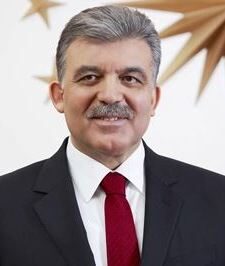
Abdullah Gül
Abdullah Gül is the 11th President of Turkey. Born October 29, 1950, in Kayseri. Positions held include President of Turkey (2007–2014), Prime Minister of Turkey (2002–2003) and Deputy Prime Minister of Turkey (2003–2007). Educated at Kayseri Science High School and Istanbul University Faculty of Economics. Awards include Honorary Knight Grand Cross of the Order of the Bath, Chatham House Prize and Grand Cross with Chain of the Order of Merit of the Republic of Hungary (civil).
Facts
39 facts · 1 confirmed by two sources · 7 cited · 31 from one source
Where this comes from
Papalocal keeps its own record. It started from these sources; what each one said is kept here as it was copied, so a change on their side never changes this page by itself. Tap one to read its version.
What Wikidata says · copied November 16, 2026 · revision 2567439128
- Described as
- 11th President of Turkey (born 1950)
- Born
- October 29, 1950 · 5 references
- Born in
- Kayseri · 1 reference
- Citizen of
- Turkey
- Occupation
- politician · 2 references; diplomat; economist
- Positions held
- President of Turkey (2007–2014); Prime Minister of Turkey (2002–2003); Deputy Prime Minister of Turkey (2003–2007); member of the Grand National Assembly of Turkey (1991–2007); Representative of the Parliamentary Assembly of the Council of Europe (2 times) (1992–2001) · 1 reference; Minister of Foreign Affairs (2003–2007) · 2 references
- Political party
- Justice and Development Party · 1 reference
- Worked for
- Sakarya University
- Education
- Kayseri Science High School; Istanbul University Faculty of Economics; University of Exeter; University of London; University of Exeter Business School; Istanbul University
- Awards
- Honorary Knight Grand Cross of the Order of the Bath (2008) · 1 reference; Chatham House Prize (2010); Grand Cross with Chain of the Order of Merit of the Republic of Hungary (civil); Grand Collar of the Order of Prince Henry · 1 reference; Knight Grand Cross of the Order of Merit of the Italian Republic; Order of King Abdulaziz al Saud; Nishan-e-Pakistan; Order of the Golden Eagle; Heydar Aliyev Order; Star of President Order; Order of Merit; Order of Independence; Royal Order of the Seraphim; Order of the Gold Lion of the House of Nassau; Order of Mubarak the Great
- Spouse
- Hayrünnisa Gül
- Religion
- Sunni Islam; Islam · 1 reference
- Website
- http://www.abdullahgul.gen.tr/EN/main.asp · 1 reference
- Wikipedias with a page
- 115
Wikidata item Q42852 (wikidata.org/wiki/Q42852), public domain (CC0). Copied November 16, 2026.
What Wikipedia says · copied November 16, 2026 · revision 1383753836
Abdullah Gül (born 29 October 1950) is a Turkish politician who served as the president of Turkey from 2007 to 2014. He previously served for four months as Prime Minister from 2002 to 2003, and concurrently served as both Deputy Prime Minister and as Foreign Minister between 2003 and 2007. He is currently a member of the Advisory Panel for the President of the Islamic Development Bank.
Advocating staunch Islamist political views during his university years, Gül became a Member of Parliament for Kayseri in 1991 and was re-elected in 1995, 1999, 2002, and 2007. Initially a member of the Islamist Welfare Party, Gül joined the Virtue Party in 1998 after the former was banned for anti-secular activities. When the party split into hardline Islamist and modernist factions in 2000, Gül joined fellow party member Recep Tayyip Erdoğan in advocating the need for reform and moderation. He ran against serving leader Recai Kutan for the Virtue Party leadership at a time when Erdoğan was banned from holding political office. As the candidate for the modernist camp, he came second with 521 votes while Kutan won 633. He co-founded the moderate Justice and Development Party (AKP) with Erdoğan in 2001 after the Virtue Party was shut down in the same year, while hardline conservative members founded the Felicity Party instead.
Gül became prime minister after the AKP won a landslide victory in the 2002 general election while Erdoğan was still banned from office. His government removed Erdoğan's political ban by March 2003, after which Erdoğan became an MP for Siirt in a by-election and took over as prime minister. Gül subsequently served as Minister of Foreign Affairs and Deputy Prime Minister until 2007. His subsequent bid for the Presidency drew strong and highly vocal opposition from ardent supporters of secularism in Turkey and was initially blocked by the Constitutional Court due to concerns over his Islamist political background. He was eventually elected Turkey's first president with a background in Islamic politics after the 2007 snap general election.
As president, Gül came under criticism for giving assent to controversial laws which have been regarded by the political opposition as unconstitutional. In June 2013, he signed a bill restricting alcohol consumption into law despite initially indicating a possible veto, which was seen as a contributing factor to sparking the Gezi Park protests. Other controversies included a law tightening internet regulation in 2013, a law increasing political control over the judiciary in 2014 designed to protect then Prime Minister Erdoğan and others from corruption charges and a law giving the National Intelligence Organization (MİT) controversial new powers also in 2014. Gül took a mediating approach during the Gezi Park anti-government protests and government corruption scandals.
- Born, in its opening lines
- October 29, 1950
From the Wikipedia article “Abdullah Gül” (en.wikipedia.org/wiki/Abdullah_Gül), by its contributors, under CC BY-SA 4.0 (creativecommons.org/licenses/by-sa/4.0/). Copied November 16, 2026; not changed.
Confirmed Two sources agree. Cited One source, and it names where it got it. One source One source, without a reference of its own. Sources disagree The sources disagree. We show the best-supported value and keep theirs below.
