
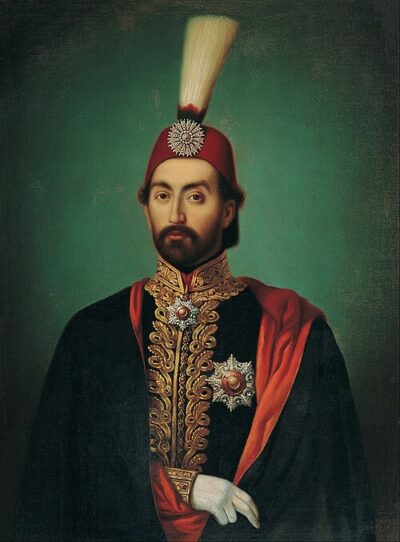
Abdülmecid I
Abdülmecid I was the 31th Sultan of the Ottoman Empire. Born April 25, 1823, in Istanbul. Died June 25, 1861, in Istanbul. Positions held include sultan of the Ottoman Empire (1839–1861). Awards include Grand Cross of the Legion of Honour, Order of St. Andrew and Order of the Medjidie.
Facts
38 facts · 2 confirmed by two sources · 7 cited · 29 from one source
Where this comes from
Papalocal keeps its own record. It started from these sources; what each one said is kept here as it was copied, so a change on their side never changes this page by itself. Tap one to read its version.
What Wikidata says · copied November 16, 2026 · revision 2565549752
- Described as
- 31th Sultan of the Ottoman Empire (1839–1861)
- Other names
- Abd-ul-Mejid I, Sultan of the Turks Abdülmecit I, Sultan Abd-al-Madschid I. Osmanisches Reich, Sultan of the Turks Abdul-Mejid I, Sultan of the Turks Abdülmecid I, Sultan of the Turks Abdülmecit, Medjid, Sultan van Turkije Abdul, Abdulmejid I, Abd-ul-Medjid, Abdul Medjid, Abdul Mejid, Abdul Medjid I
- Born
- April 25, 1823 · 1 reference
- Died
- June 25, 1861 · 4 references
- Born in
- Istanbul · 1 reference
- Died in
- Istanbul · 1 reference
- Buried in
- Yavuz Selim Mosque
- Cause of death
- tuberculosis
- Citizen of
- Ottoman Empire · 1 reference
- Occupation
- ruler
- Positions held
- sultan of the Ottoman Empire (1839–1861) · 1 reference
- Member of
- Ottoman dynasty · 1 reference
- Awards
- Grand Cross of the Legion of Honour; Order of St. Andrew; Order of the Medjidie · 1 reference; Order of the Garter · 1 reference
- Spouse
- Şevkefza Sultan; Tirimüjgan Kadın; Yıldız Hanım Efendi (1858–) · 1 reference; Gülcemal Kadin; Şayeste Hanım · 1 reference; Verdicenan Kadı · 1 reference
- Children
- Mehmed V; Abdul Hamid II; Mehmed VI; Murad V · 1 reference; Şehzade Mehmed Burhaneddin · 1 reference; Şehzade Ahmed Kemaleddin; Naile Sultan; Cemile Sultan · 1 reference; Seniha Sultan · 1 reference; Mediha Sultan · 1 reference; Refia Sultan · 1 reference; Fatma Sultan · 1 reference
- Father
- Mahmud II · 1 reference
- Mother
- Bezmiâlem Sultan
- Siblings
- Adile Sultan; Abdülaziz
- Religion
- Islam · 1 reference
- Lived in
- Dolmabahçe Palace · 1 reference
- Wikipedias with a page
- 74
Wikidata item Q174772 (wikidata.org/wiki/Q174772), public domain (CC0). Copied November 16, 2026.
What Wikipedia says · copied November 16, 2026 · revision 1385736340
Abdülmecid I (Ottoman Turkish: عبد المجید اول, romanized: ʿAbdü'l-Mecîd, Turkish: I. Abdülmecid; 25 April 1823 – 25 June 1861) was the 31st sultan of the Ottoman Empire. He succeeded his father Mahmud II on 2 July 1839.
Abdulmejid's greatest achievement was the announcement of the Tanzimat Edict upon his accession, prepared by his then Foreign Minister Mustafa Reshid Pasha, which effectively began the Tanzimat era, or era of reorganization, in the Ottoman Empire. He was a mild-mannered monarch, giving the Sublime Porte the autonomy needed for its reform projects. One of the main goals of the Tanzimat was to encourage Ottomanism among the millets to stop rising nationalist movements within the empire, but despite new laws and reforms to integrate non-Muslims and non-Turks more thoroughly into Ottoman society, in the long term, the movement failed.
Abdulmejid forged alliances with the major powers of Western Europe, namely the United Kingdom and France, which fought alongside the Ottoman Empire in the Crimean War against Russia. During the Congress of Paris on 30 March 1856, the Ottoman Empire was officially included among the Concert of Europe. Abdulmejid suddenly died of tuberculosis and he was succeeded by his half-brother, Abdul Aziz.
- Born, in its opening lines
- April 25, 1823
- Died, in its opening lines
- June 25, 1861
From the Wikipedia article “Abdülmecid I” (en.wikipedia.org/wiki/Abdülmecid_I), by its contributors, under CC BY-SA 4.0 (creativecommons.org/licenses/by-sa/4.0/). Copied November 16, 2026; not changed.
Confirmed Two sources agree. Cited One source, and it names where it got it. One source One source, without a reference of its own. Sources disagree The sources disagree. We show the best-supported value and keep theirs below.
