
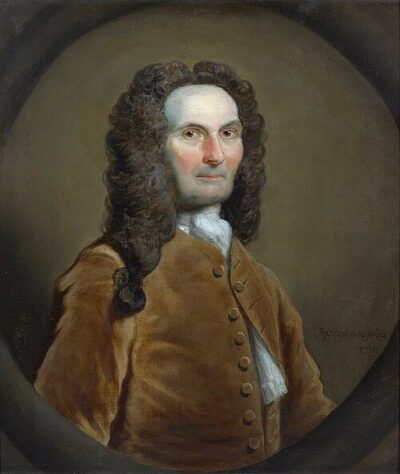
Abraham de Moivre
Abraham de Moivre was a French mathematician (*1667 – †1754). Born May 26, 1667, in Vitry-le-François. Died November 27, 1754, in London. Known for de Moivre's formula and De mensura sortis, seu, de probabilitate eventuum in ludis a casu fortuito pendentibus. Educated at Academy of Saumur and collège d’Harcourt.
Facts
21 facts · 2 confirmed by two sources · 15 cited · 4 from one source
Where this comes from
Papalocal keeps its own record. It started from these sources; what each one said is kept here as it was copied, so a change on their side never changes this page by itself. Tap one to read its version.
What Wikidata says · copied November 16, 2026 · revision 2567441532
- Described as
- French mathematician (*1667 – †1754)
- Other names
- Abraham Demoivre
- Born
- May 26, 1667 · 3 references
- Died
- November 27, 1754 · 5 references
- Born in
- Vitry-le-François · 2 references
- Died in
- London · 2 references
- Buried in
- St Martin-in-the-Fields · 1 reference
- Citizen of
- France
- Occupation
- mathematician · 2 references; statistician; astronomer · 1 reference
- Education
- Academy of Saumur (1682–1684) · 2 references; collège d’Harcourt (1684–1685) · 2 references; Academy of Sedan (1678–1682) · 1 reference
- Member of
- Royal Society of London (1697–) · 1 reference; French Academy of Sciences (1754–) · 1 reference; Royal Prussian Academy of Sciences (1735–) · 1 reference
- Known for
- de Moivre's formula · 1 reference; De mensura sortis, seu, de probabilitate eventuum in ludis a casu fortuito pendentibus
- Field
- probability theory · 1 reference; mathematics · 1 reference; statistics · 1 reference; astronomy · 1 reference
- Wikipedias with a page
- 58
Wikidata item Q200397 (wikidata.org/wiki/Q200397), public domain (CC0). Copied November 16, 2026.
What Wikipedia says · copied November 16, 2026 · revision 1374261488
Abraham de Moivre (French pronunciation: [abʁaam də mwavʁ]; 26 May 1667 – 27 November 1754) was a French mathematician known for de Moivre's formula, a formula that links complex numbers and trigonometry, and for his work on the normal distribution and probability theory.
He moved to England at a young age due to the religious persecution of Huguenots in France which reached a climax in 1685 with the Edict of Fontainebleau.
He was a friend of Isaac Newton, Edmond Halley, and James Stirling. Among his fellow Huguenot exiles in England, he was a colleague of the editor and translator Pierre des Maizeaux.
De Moivre wrote a book on probability theory, The Doctrine of Chances, said to have been prized by gamblers. De Moivre first discovered Binet's formula, the closed-form expression for Fibonacci numbers linking the nth power of the golden ratio φ to the nth Fibonacci number. He also was the first to postulate the central limit theorem, a cornerstone of probability theory, of which he proved a special case.
- Born, in its opening lines
- May 26, 1667
- Died, in its opening lines
- November 27, 1754
From the Wikipedia article “Abraham de Moivre” (en.wikipedia.org/wiki/Abraham_de_Moivre), by its contributors, under CC BY-SA 4.0 (creativecommons.org/licenses/by-sa/4.0/). Copied November 16, 2026; not changed.
Confirmed Two sources agree. Cited One source, and it names where it got it. One source One source, without a reference of its own. Sources disagree The sources disagree. We show the best-supported value and keep theirs below.
