
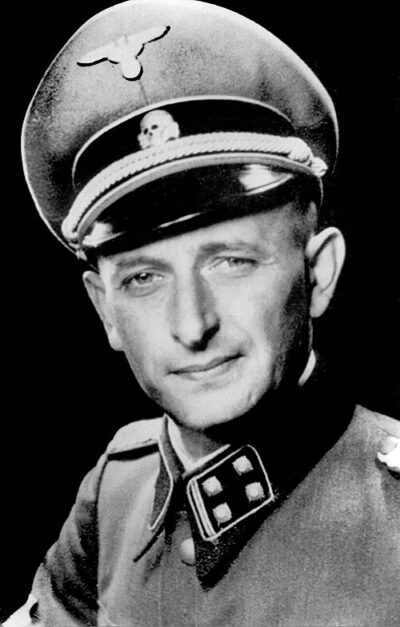
Adolf Eichmann
Adolf Eichmann was a German-Austrian SS officer and one of the major organizers of the Holocaust. Born March 19, 1906, in Solingen. Died May 31, 1962, in Ramla. Positions held include Lieutenant Colonel. Educated at Bundesrealgymnasium Linz Fadingerstraße. Awards include Anschluss Medal, Iron Cross (1939), 2nd class and Honour Chevron for the Old Guard.
Facts
41 facts · 1 confirmed by two sources · 19 cited · 20 from one source · 1 where the sources disagree
What’s different
- Died: we show May 31, 1962 (Sources disagree). Wikipedia says June 1, 1962
Where this comes from
Papalocal keeps its own record. It started from these sources; what each one said is kept here as it was copied, so a change on their side never changes this page by itself. Tap one to read its version.
What Wikidata says · copied November 16, 2026 · revision 2568065590
- Described as
- German-Austrian SS officer and one of the major organizers of the Holocaust (1906–1962)
- Other names
- Eichmann Ottó Adolf, Klement Richárd, Adolf Otto Eichmann, Otto Adolf Eichmann, Eichmann, Ricardo Klement
- Born
- March 19, 1906 · 11 references
- Died
- May 31, 1962 · 3 references
- Born in
- Solingen · 4 references
- Died in
- Ramla · 5 references
- Buried in
- Mediterranean Sea
- Cause of death
- hanging to death
- Name at birth
- Otto Adolf Eichmann
- Citizen of
- Nazi Germany; Weimar Republic; Austria · 2 references; Germany · 1 reference
- Occupation
- politician; police officer; military officer · 2 references; salesperson · 2 references; Holocaust perpetrator · 1 reference
- Positions held
- Lieutenant Colonel · 1 reference
- Political party
- Nazi Party (1932–) · 2 references
- Worked for
- Reich Main Security Office · 1 reference
- Education
- Bundesrealgymnasium Linz Fadingerstraße
- Member of
- Allgemeine SS
- Awards
- Anschluss Medal · 1 reference; Iron Cross (1939), 2nd class (1944) · 1 reference; Honour Chevron for the Old Guard · 1 reference; SA Sports Badge in Bronze · 1 reference; SS-Ehrenring · 1 reference; War Merit Cross 2nd Class with Swords (1944) · 1 reference; War Merit Cross 1st Class with Swords (1944) · 1 reference; SS Zivilabzeichen · 1 reference
- Field
- Nazism · 1 reference; The Holocaust · 1 reference; war crime · 1 reference
- Spouse
- Veronika Eichmann (1935–1962)
- Children
- Ricardo Eichmann · 1 reference; Klaus Eichmann; Dieter Eichmann; Klaus Eichmann · 1 reference
- Father
- Adolf Karl Eichmann
- Mother
- Maria Eichmann
- Military branch
- Schutzstaffel
- Military rank
- Obersturmbannführer
- Wikipedias with a page
- 94
Wikidata item Q28085 (wikidata.org/wiki/Q28085), public domain (CC0). Copied November 16, 2026.
What Wikipedia says · copied November 16, 2026 · revision 1383861618
Otto Adolf Eichmann ( EYEKH-mən; German pronunciation: [ˈʔɔto ˈʔaːdɔlf ˈʔaɪçman] ; 19 March 1906 – 1 June 1962) was a German-Austrian official of the Nazi Party, an officer of the Schutzstaffel (SS), a convicted war criminal, and one of the major organizers of the Holocaust. He participated in the January 1942 Wannsee Conference, at which the implementation of the genocidal Final Solution to the Jewish Question was planned. Following this, he was tasked by SS-Obergruppenführer Reinhard Heydrich with facilitating and managing the logistics involved in the mass deportation of millions of Jews to Nazi ghettos and Nazi extermination camps across German-occupied Europe. He was captured and detained by the Allies in 1945, but he escaped and eventually settled in Argentina. In May 1960, he was tracked down and abducted by Israel's Mossad intelligence agency and put on trial before a special tribunal of the Jerusalem District Court. The highly publicised Eichmann trial resulted in his conviction in Jerusalem, following which he was executed by hanging in 1962.
After doing poorly in school, Eichmann briefly worked for his father's mining company in Austria, where the family had moved in 1914. He worked as a travelling oil salesman beginning in 1927, and joined both the Nazi Party and the SS in 1932. He returned to Germany in 1933, where he joined the Sicherheitsdienst (SD, "Security Service"); there he was appointed head of the department responsible for Jewish affairs – especially emigration, which the Nazis encouraged through violence and economic pressure. After the outbreak of the Second World War in September 1939, Eichmann and his staff arranged for Jews to be concentrated in ghettos in major cities with the expectation that they would be transported either farther east or overseas. He also drew up plans for a Jewish reservation, first at Nisko in southeast Poland and later in Madagascar, but neither of these plans was carried out.
The Nazis began the invasion of the Soviet Union on 22 June 1941, and their Jewish policy changed from internment or coerced emigration to extermination. To coordinate planning for the genocide, Eichmann's superior Reinhard Heydrich hosted the regime's administrative leaders at the Wannsee Conference on 20 January 1942. Eichmann collected information for him, attended the conference, and prepared the minutes. Eichmann and his staff became responsible for Jewish deportations to extermination camps, where the victims were gassed. After Germany occupied Hungary in March 1944, Eichmann oversaw the deportation of much of the Jewish population. By the time the transports were stopped in July 1944, 437,000 of Hungary's 725,000 Jews had been deported. Most of the victims were sent to Auschwitz concentration camp, where about 75 per cent were murdered upon arrival. Dieter Wisliceny testified at Nuremberg that Eichmann told him he would "leap laughing into the grave because the feeling that he had five million people on his conscience would be for him a source of extraordinary satisfaction".
After Germany's defeat in 1945, Eichmann was captured by US forces, but he escaped from a detention camp and moved around Germany to avoid recapture. He ended up in a small village in Lower Saxony, where he lived until 1950 when he moved to Argentina using false papers he obtained with help from an organisation directed by Catholic bishop Alois Hudal. Information collected by Mossad, Israel's intelligence agency, confirmed his location in 1960. A team of Mossad and Shin Bet agents captured Eichmann and brought him to Israel to stand trial on 15 criminal charges, including war crimes, crimes against humanity, and crimes against the Jewish people. During the trial, he did not deny the Holocaust or his role in organising it, but said he was simply following orders in a totalitarian Führerprinzip system. He was found guilty on all of the charges, and was executed by hanging on 1 June 1962. The trial was widely followed in the media and was later the subject of several books, including Hannah Arendt's Eichmann in Jerusalem, in which Arendt coined the phrase "the banality of evil" to describe Eichmann.
- Born, in its opening lines
- March 19, 1906
- Died, in its opening lines
- June 1, 1962
From the Wikipedia article “Adolf Eichmann” (en.wikipedia.org/wiki/Adolf_Eichmann), by its contributors, under CC BY-SA 4.0 (creativecommons.org/licenses/by-sa/4.0/). Copied November 16, 2026; not changed.
Confirmed Two sources agree. Cited One source, and it names where it got it. One source One source, without a reference of its own. Sources disagree The sources disagree. We show the best-supported value and keep theirs below.
