
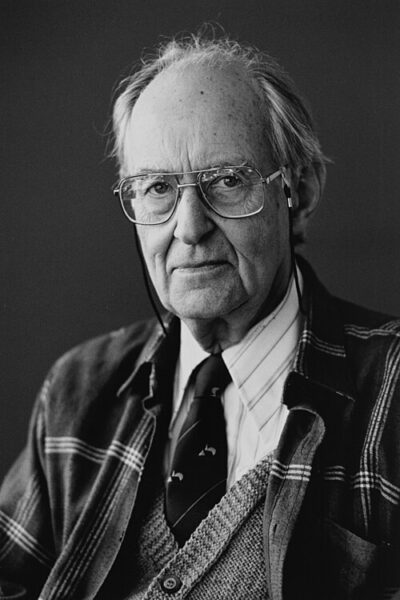
Adriaan Blaauw
Adriaan Blaauw was a Dutch astronomer. Born April 12, 1914, in Amsterdam. Died December 1, 2010, in Groningen. Positions held include president (1976–1979) and ESO’s Director General (1970–1974). Educated at Leiden University and University of Groningen. Awards include honorary doctor of the Marie and Louis Pasteur University, Prix Jules Janssen and Bruce Medal.
Facts
24 facts · 2 confirmed by two sources · 12 cited · 10 from one source
Where this comes from
Papalocal keeps its own record. It started from these sources; what each one said is kept here as it was copied, so a change on their side never changes this page by itself. Tap one to read its version.
What Wikidata says · copied November 17, 2026 · revision 2569717873
- Described as
- Dutch astronomer (1914–2010)
- Other names
- A. Blaauw
- Born
- April 12, 1914 · 6 references
- Died
- December 1, 2010 · 6 references
- Born in
- Amsterdam · 1 reference
- Died in
- Groningen · 1 reference
- Citizen of
- Kingdom of the Netherlands · 1 reference
- Occupation
- astronomer · 1 reference; university teacher · 1 reference
- Positions held
- president (1976–1979); ESO’s Director General (1970–1974)
- Worked for
- University of Groningen (1957–) · 1 reference; European Southern Observatory; Leiden University (1948–) · 1 reference
- Education
- Leiden University; University of Groningen
- Member of
- American Academy of Arts and Sciences; Royal Netherlands Academy of Arts and Sciences; International Astronomical Union · 1 reference; Academia Europaea (1993–) · 1 reference
- Awards
- honorary doctor of the Marie and Louis Pasteur University (1961) · 1 reference; Prix Jules Janssen (1978); Bruce Medal (1989) · 1 reference; honorary doctorate of Paris Observatory, PSL University (2004) · 1 reference; Fellow of the American Academy of Arts and Sciences
- Field
- astronomy · 1 reference
- Wikipedias with a page
- 27
Wikidata item Q360028 (wikidata.org/wiki/Q360028), public domain (CC0). Copied November 17, 2026.
What Wikipedia says · copied November 17, 2026 · revision 1381463363
Adriaan Blaauw (12 April 1914 – 1 December 2010) was a Dutch astronomer.
Blaauw was born in Amsterdam to Cornelis Blaauw and Gesina Clasina Zwart, and studied at Leiden University and the University of Groningen, obtaining his doctorate at the latter in 1946. In 1948, he was appointed an associate professor at Leiden. In the 1950s he worked a few years at the Yerkes Observatory, before returning to Europe in 1957 to become director of the Kapteyn Astronomical Institute in Groningen. Blaauw was closely involved in the founding of the European Southern Observatory, and was its general director from 1970 to 1975. In 1975, he
returned to the Netherlands, becoming a full professor at Leiden, until his retirement in 1981. From 1976 to 1979, he served as president of the International Astronomical Union. He chaired the committee for assigning scientific priorities for the observing programme of the astrometric satellite Hipparcos. His research has involved star formation, the motions of star clusters and stellar associations, and distance scale. His main contributions are the explanation of the origin of stars that move with high velocity in our galaxy and the description of star formation in associations.
Among his many honours he was made member of the Royal Netherlands Academy of Arts and Sciences in 1963, elected a Foreign Honorary Member of the American Academy of Arts and Sciences in 1973. He was awarded the Prix Jules Janssen by the Société astronomique de France in 1978. In 1989, he was awarded the Bruce Medal. In 1997, the University of Groningen instituted a Blaauw chair and Blaauw lecture in his honour. The asteroid 2145 Blaauw and the Blaauw Observatory are named after him. He died in 2010 in the city of Groningen.
- Born, in its opening lines
- April 12, 1914
- Died, in its opening lines
- December 1, 2010
From the Wikipedia article “Adriaan Blaauw” (en.wikipedia.org/wiki/Adriaan_Blaauw), by its contributors, under CC BY-SA 4.0 (creativecommons.org/licenses/by-sa/4.0/). Copied November 17, 2026; not changed.
Confirmed Two sources agree. Cited One source, and it names where it got it. One source One source, without a reference of its own. Sources disagree The sources disagree. We show the best-supported value and keep theirs below.
