
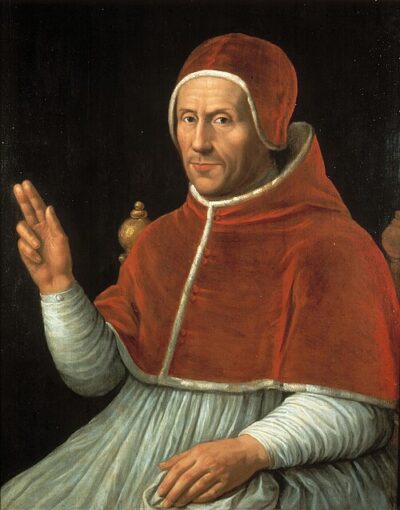
Adrian VI
Adrian VI was a pope of the Catholic Church from 1522 to 1523. Born March 2, 1459, in Utrecht. Died September 14, 1523, in Rome. Positions held include Pope (1522–1523), Inquisitor General of Aragon (1516–1518) and High Inquisitor of Castille (1518–1522). Educated at Old University of Leuven.
Facts
22 facts · 2 confirmed by two sources · 8 cited · 12 from one source
Where this comes from
Papalocal keeps its own record. It started from these sources; what each one said is kept here as it was copied, so a change on their side never changes this page by itself. Tap one to read its version.
What Wikidata says · copied November 16, 2026 · revision 2569028502
- Described as
- pope of the Catholic Church from 1522 to 1523 (1459–1523)
- Other names
- Hadrianus VI, Pope Adrian VI, Adriaan Florenszoon Boeyens
- Born
- March 2, 1459 · 3 references
- Died
- September 14, 1523 · 2 references
- Born in
- Utrecht · 1 reference
- Died in
- Rome · 1 reference
- Buried in
- Funeral monument of Pope Adrian VI
- Name at birth
- Adriaan Florenszoon Boeyens d'Edel
- Citizen of
- Holy Roman Empire; Papal States
- Occupation
- theologian; university teacher; Catholic priest (1490–) · 1 reference; philosopher · 1 reference; Catholic bishop · 1 reference
- Positions held
- Pope (1522–1523); Inquisitor General of Aragon (1516–1518) · 1 reference; High Inquisitor of Castille (1518–1522) · 1 reference; cardinal priest (1517–1522) · 1 reference; Roman Catholic Bishop of Tortosa (1516–1522) · 2 references; regent
- Worked for
- Universities in Leuven
- Education
- Old University of Leuven
- Religion
- Catholic Church · 1 reference
- Wikipedias with a page
- 87
Wikidata item Q57087 (wikidata.org/wiki/Q57087), public domain (CC0). Copied November 16, 2026.
What Wikipedia says · copied November 16, 2026 · revision 1364510985
Pope Adrian VI (Latin: Hadrianus VI; Italian: Adriano VI; German: Hadrian VI.; Dutch: Adrianus/Adriaan VI), born Adriaan Florensz Boeyens (2 March 1459 – 14 September 1523), was head of the Catholic Church and leader of the Papal States from 9 January 1522 until his death on 14 September 1523. The only Dutchman to become pope, he was the last non-Italian pope until the Polish John Paul II 455 years later.
Born in the Episcopal principality of Utrecht of the Holy Roman Empire of the German Nation, Adrian studied at the University of Leuven in the Low Countries, where he rose to the position of professor of theology, also serving as its rector (the equivalent of president or vice-chancellor). In 1507, he became the tutor of the future Charles V, Holy Roman Emperor, who later trusted him as both his emissary and his regent. In 1516, Charles, now King of Castile and Aragon, appointed Adrian bishop of Tortosa, Spain, and soon thereafter Grand Inquisitor of the kingdoms of Aragon and Castile. Pope Leo X made him a cardinal in 1517 and after Leo's death he was elected pope in 1522 as a compromise candidate.
Adrian came to the papacy in the midst of one of its greatest crises, threatened not only by Lutheranism to the north but also by the advance of the Ottoman Turks to the east. He refused to compromise with Lutheranism theologically, demanding Luther's condemnation as a heretic. However, he is noted for having attempted to reform the Catholic Church administration in response to the Protestant Reformation. Adrian's admission that the Roman Curia itself was at fault for the turmoil in the Church was read at the 1522–1523 Diet of Nuremberg.
His efforts at reform proved fruitless, as they were resisted by most of his contemporaries, and he did not live long enough to see his efforts through to their conclusion. He was succeeded by the second Medici pope, Clement VII. Adrian VI and Marcellus II are the only popes of the modern era to retain their baptismal names after their election. Adrian VI is also the last pope to date to use the pontifical name "Adrian".
- Born, in its opening lines
- March 2, 1459
- Died, in its opening lines
- September 14, 1523
From the Wikipedia article “Pope Adrian VI” (en.wikipedia.org/wiki/Pope_Adrian_VI), by its contributors, under CC BY-SA 4.0 (creativecommons.org/licenses/by-sa/4.0/). Copied November 16, 2026; not changed.
Confirmed Two sources agree. Cited One source, and it names where it got it. One source One source, without a reference of its own. Sources disagree The sources disagree. We show the best-supported value and keep theirs below.
