
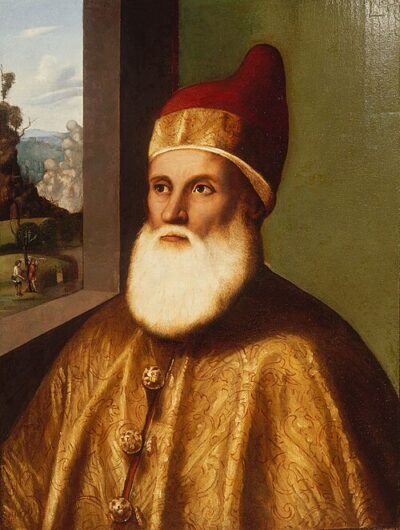
Agostino Barbarigo
Agostino Barbarigo was a Doge of Venice. Born June 3, 1419, in Venice. Died August 20, 1501, in Venice. Positions held include Doge of Venice (1486–1501), podestà (1478) and stadtholder.
Facts
17 facts · 1 confirmed by two sources · 7 cited · 8 from one source · 1 where the sources disagree
What’s different
- Died: we show August 20, 1501 (Sources disagree). Wikipedia says September 20, 1501
Where this comes from
Papalocal keeps its own record. It started from these sources; what each one said is kept here as it was copied, so a change on their side never changes this page by itself. Tap one to read its version.
What Wikidata says · copied November 18, 2026 · revision 2567382304
- Described as
- Doge of Venice (1486–1501)
- Born
- June 3, 1419 · 1 reference
- Died
- August 20, 1501
- Born in
- Venice · 1 reference
- Died in
- Venice · 1 reference
- Buried in
- Santa Maria della Carità
- Citizen of
- Republic of Venice
- Occupation
- politician; military personnel · 1 reference; doge · 1 reference
- Positions held
- Doge of Venice (1486–1501) · 1 reference; podestà (1478) · 1 reference; stadtholder · 1 reference; Podestà of Verona (1478–) · 1 reference
- Spouse
- Elisabetta Soranzo
- Father
- Francesco Barberigo
- Siblings
- Marco Barbarigo
- Religion
- Catholicism
- Wikipedias with a page
- 23
Wikidata item Q395582 (wikidata.org/wiki/Q395582), public domain (CC0). Copied November 18, 2026.
What Wikipedia says · copied November 18, 2026 · revision 1374412651
Agostino Barbarigo (3 June 1419 – 20 September 1501) was Doge of Venice from 1486 until his death in 1501.
While he was Doge, the imposing Clock Tower in the Piazza San Marco with its archway through which the street known as the Merceria leads to the Rialto, was designed and completed. A figure of the Doge was originally shown kneeling before the lion of Venice on the top storey below the bell but this was removed by the French in 1797 after Venice had surrendered to Napoleon.
In 1495 he created an Italian coalition to push back Charles VIII of France from Italy, which led to the Battle of Fornovo during the French retreat from Italy. During his reign Venice gained several strongholds in Romagna and annexed the island of Cyprus.
His relationships with the Ottoman sultan Bayezid II were initially amicable, but they became increasingly strained starting from 1492, eventually leading to open war in 1499. The Venetian merchants in Istanbul were arrested, while Bosnian troops invaded Dalmatia and reached Zara. The Venetian fleet was defeated at the Battle of Zonchio, and the Republic lost its base in Lepanto. The latter was soon followed by Modone and Corone, which meant the loss of all the main intermediate stops for the Venetian ships sailing towards the Levante.
Despite his personal opposition, in February 1499 Venice signed the Treaty of Blois, a military alliance with Louis XII of France against their long-standing rival, the Duchy of Milan. Barbarigo believed it to be a distraction from the Ottoman threat; a peace treaty was signed in 1503, which left Venice holding only Nafplion, Patras and Monemvasia in Morea.
His dogaressa was Elisabetta Soranzo. His brother Marco Barbarigo preceded him as Doge but held office for less than a year; their tomb, originally in the church of the Carita, has been demolished. Part of it, a relief showing the Resurrection of Christ, is in the Scuola di San Giovanni Evangelista, attributed to the workshop of Antonio Rizzo.
- Born, in its opening lines
- June 3, 1419
- Died, in its opening lines
- September 20, 1501
From the Wikipedia article “Agostino Barbarigo” (en.wikipedia.org/wiki/Agostino_Barbarigo), by its contributors, under CC BY-SA 4.0 (creativecommons.org/licenses/by-sa/4.0/). Copied November 18, 2026; not changed.
Confirmed Two sources agree. Cited One source, and it names where it got it. One source One source, without a reference of its own. Sources disagree The sources disagree. We show the best-supported value and keep theirs below.
