
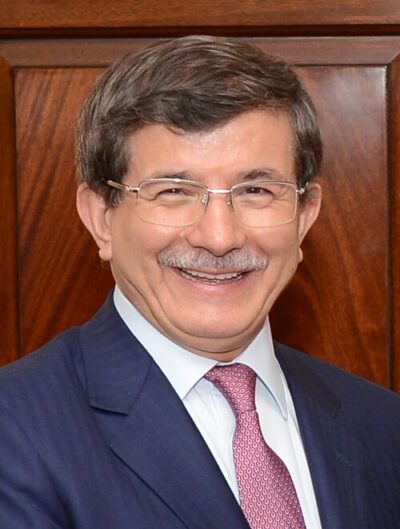
Ahmet Davutoğlu
Ahmet Davutoğlu is a Turkish statesperson and writer. Born February 26, 1959, in Konya. Positions held include Prime Minister of Turkey (2014–2016), member of the Grand National Assembly of Turkey (2015–) and ambassador of Turkey. Educated at Boğaziçi University and Istanbul High School.
Facts
24 facts · 1 confirmed by two sources · 9 cited · 13 from one source · 1 where the sources disagree
What’s different
- Born in: we show Konya (Sources disagree). Wikidata also lists Taşkent
Where this comes from
Papalocal keeps its own record. It started from these sources; what each one said is kept here as it was copied, so a change on their side never changes this page by itself. Tap one to read its version.
What Wikidata says · copied November 16, 2026 · revision 2569162771
- Described as
- Turkish statesperson and writer (born 1959)
- Born
- February 26, 1959 · 4 references
- Born in
- Taşkent; Konya · 1 reference
- Citizen of
- Turkey
- Occupation
- diplomat; politician · 2 references; political scientist · 1 reference; pedagogue; writer; professor; economist · 1 reference; university teacher · 1 reference
- Positions held
- Prime Minister of Turkey (2014–2016); member of the Grand National Assembly of Turkey (2015–); ambassador of Turkey; Minister of Foreign Affairs (2009–2014) · 1 reference
- Political party
- Justice and Development Party (2002–2019) · 2 references; Future Party (Turkey) (2019–)
- Worked for
- Istanbul Beykent University
- Education
- Boğaziçi University; Istanbul High School
- Field
- international relations · 1 reference; foreign policy · 1 reference
- Spouse
- Sare Davutoğlu · 2 references
- Religion
- Sunni Islam
- Wikipedias with a page
- 89
Wikidata item Q58198 (wikidata.org/wiki/Q58198), public domain (CC0). Copied November 16, 2026.
What Wikipedia says · copied November 16, 2026 · revision 1384907943
Ahmet Davutoğlu (born 26 February 1959) is a Turkish academic, politician and former diplomat who served as the 26th Prime Minister of Turkey and Leader of the Justice and Development Party (AKP) from 2014 to 2016. He previously served as Minister of Foreign Affairs from 2009 to 2014 and chief advisor to Prime Minister Recep Tayyip Erdoğan from 2003 to 2009. He was elected as an AKP Member of Parliament for Konya in the 2011 general election and was reelected as an MP in both the June and November 2015 general elections. He resigned as prime minister on 22 May 2016.
Following the election of serving prime minister and AKP Leader Recep Tayyip Erdoğan as the 12th President of Turkey, Davutoğlu was announced by the AKP Central Executive Committee as an official candidate for the party leadership. He was unanimously elected as leader during the first AKP extraordinary congress and consequently succeeded Erdoğan as prime minister, forming the 62nd Government of the Turkish Republic. His cabinet was dominated by Erdoğan's close allies such as Yalçın Akdoğan; this led to speculation that he would take a docile approach as prime minister while Erdoğan continued to pursue his own political agenda as president. The AKP lost its parliamentary majority in the June 2015 general election, though it remained the largest party. Davutoğlu's government subsequently resigned but stayed in power until a new government could be formed. After undertaking a series of unsuccessful coalition negotiations with opposition parties, Davutoğlu was tasked with forming Turkey's first-ever interim election government, which presided over snap elections scheduled for November 2015. The AKP regained its parliamentary majority in November after a landslide victory, with Davutoğlu subsequently forming his third government.
Following a deterioration in relations between Davutoğlu and Erdoğan over their disagreements regarding parliamentary candidate lists, government policy and the implementation of an executive presidential system of government, Davutoğlu announced his resignation as AKP leader and prime minister seven months after his November 2015 general election victory. He announced that an Extraordinary party Congress would be held on 22 May 2016 and that he would not stand for re-election for the party leadership. He was succeeded as leader by Binali Yıldırım and tendered his resignation as Prime Minister soon afterward.
Davutoğlu's administration oversaw an escalation of conflict between the government and the Kurdistan Workers' Party (PKK) after a two-year ceasefire broke down in mid-2015, with his premiership being described as the 'bloodiest' in Turkey's history. His government originally authorised airstrikes against both PKK and Islamic State of Iraq and the Levant (ISIL) positions on 20 July after a suicide bombing killed 32 people in the southeastern town of Suruç. The government's offensive against ISIL suffered sustained criticism by allies such as the United States over Turkey's lack of action against the group, though the political opposition accused Davutoğlu of sparking the conflict deliberately to win back votes and regain a parliamentary majority in the November 2015 snap election. His government also presided over the ongoing political conflict with the Gülen Movement and the spillover effects of the Syrian Civil War across the border with Turkey, as well as the European migrant crisis that emerged as a result. Although his foreign policy outlook has been described as Neo-Ottoman or Pan-Islamist, Davutoğlu made Turkey's accession bid to the European Union a strategic target for his government. He has been criticised for failing to tackle political corruption and for growing government authoritarianism, with a new national security bill in early 2015 causing opposition commentators to accuse his government of turning Turkey into a police state.
In September 2019, having long been speculated to be preparing to launch his own party, Davutoğlu resigned from the AKP and accused his former party of no longer being able to provide solutions for Turkey. On 12 December 2019, he launched the Future Party (GP) and became its first leader; the party eventually became a member of the Nation Alliance, opposing AKP and Erdoğan.
- Born, in its opening lines
- February 26, 1959
From the Wikipedia article “Ahmet Davutoğlu” (en.wikipedia.org/wiki/Ahmet_Davutoğlu), by its contributors, under CC BY-SA 4.0 (creativecommons.org/licenses/by-sa/4.0/). Copied November 16, 2026; not changed.
Confirmed Two sources agree. Cited One source, and it names where it got it. One source One source, without a reference of its own. Sources disagree The sources disagree. We show the best-supported value and keep theirs below.
