
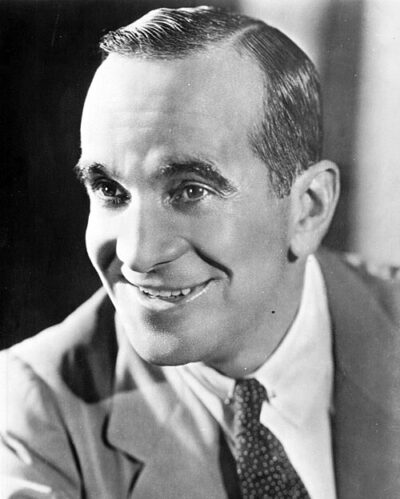
Al Jolson
Al Jolson was an American entertainer, actor, and singer. Born May 26, 1886, in Seredžius. Died October 23, 1950, in San Francisco. Awards include star on Hollywood Walk of Fame and Medal for Merit.
Facts
35 facts · 2 confirmed by two sources · 3 cited · 30 from one source
Where this comes from
Papalocal keeps its own record. It started from these sources; what each one said is kept here as it was copied, so a change on their side never changes this page by itself. Tap one to read its version.
What Wikidata says · copied November 13, 2026 · revision 2568888605
- Described as
- American entertainer, actor, and singer (1886–1950)
- Other names
- Asa Yoelson
- Born
- May 26, 1886 · 11 references
- Died
- October 23, 1950 · 11 references
- Born in
- Seredžius
- Died in
- San Francisco · 4 references
- Buried in
- Hillside Memorial Park
- Cause of death
- myocardial infarction
- Name at birth
- Asa Yoelson
- Citizen of
- Russian Empire; United States
- Occupation
- actor · 2 references; film actor; singer · 1 reference; jazz musician; stage actor; comedian; songwriter; vaudeville performer
- Political party
- Republican Party
- Worked for
- Warner Bros. Entertainment
- Member of
- Temple Israel of Hollywood · 1 reference
- Genre
- jazz; blues; ragtime; pop music; vaudeville; traditional pop
- Instrument
- voice
- Record label
- Decca; Victor
- Awards
- star on Hollywood Walk of Fame · 1 reference; Medal for Merit
- Spouse
- Ruby Keeler (1928–1940); Erle Krasna (1945–)
- Siblings
- Harry Jolson
- Website
- http://www.jolson.org/
- Wikipedias with a page
- 42
Wikidata item Q128532 (wikidata.org/wiki/Q128532), public domain (CC0). Copied November 13, 2026.
What Wikipedia says · copied November 13, 2026 · revision 1385042637
Al Jolson (born Asa Yoelson; c. 26 May [N.S. 7 June] 1886 – October 23, 1950) was a Lithuanian-American singer, comedian, actor and vaudevillian.
Self-billed as "The World's Greatest Entertainer", Jolson was one of the United States' most famous and highest-paid stars of the 1910s and 1920s. He was known for his "shamelessly sentimental, melodramatic approach" towards performing, along with popularizing many of the songs he sang. According to music historian Larry Stempel, "No one had heard anything quite like it before on Broadway." Stephen Banfield wrote that Jolson's style was "arguably the single most important factor in defining the modern musical." Jolson has been referred to by modern critics as "the king of blackface performers".
Although best remembered today as the star of the first major talking picture, The Jazz Singer (1927), he starred in a series of successful musical films during the 1930s. After the attack on Pearl Harbor in December 1941, he was the first star to entertain troops overseas during World War II. After a period of inactivity, his stardom returned with The Jolson Story (1946), in which Larry Parks played the younger Jolson, but with sung vocals dubbed by Jolson himself. The formula was repeated in a sequel, Jolson Sings Again (1949). In 1950, he again became the first star to entertain GIs on active service in the Korean War, performing 42 shows in 16 days. He died weeks after returning to the U.S., partly owing to the physical exhaustion from the performance schedule. Defense Secretary George Marshall posthumously awarded him the Medal for Merit.
With his dynamic style of singing, he became widely successful by extracting traditionally black music and popularizing it for White American audiences. Despite his promotion and perpetuation of Black stereotypes of the time, his work was often well regarded by Black publications, and he has been credited for fighting against Black discrimination on Broadway as early as 1911. In an essay written in 2000, music critic Ted Gioia remarked, "If blackface has its shameful poster boy, it is Al Jolson", showcasing Jolson's complex legacy in American society.
- Born, in its opening lines
- May 26, 1886
- Died, in its opening lines
- October 23, 1950
From the Wikipedia article “Al Jolson” (en.wikipedia.org/wiki/Al_Jolson), by its contributors, under CC BY-SA 4.0 (creativecommons.org/licenses/by-sa/4.0/). Copied November 13, 2026; not changed.
Confirmed Two sources agree. Cited One source, and it names where it got it. One source One source, without a reference of its own. Sources disagree The sources disagree. We show the best-supported value and keep theirs below.
