
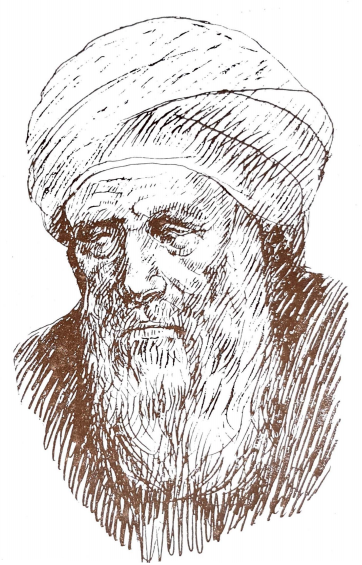
al-Ma'arri was a medieval Arab poet and thinker. Born December 973, in Ma'arrat Nu'man. Died May 9, 1057, in Ma'arrat Nu'man. Known for Resalat Al-Ghufran, Saqt az-Zand and Diwan al-Lazumiyat.
Facts
18 facts · 2 confirmed by two sources · 7 cited · 9 from one source
Where this comes from
Papalocal keeps its own record. It started from these sources; what each one said is kept here as it was copied, so a change on their side never changes this page by itself. Tap one to read its version.
What Wikidata says · copied November 16, 2026 · revision 2567396275
- Described as
- medieval Arab poet and thinker
- Other names
- Abū al-ʻAlāʼ al-Maʻarrī, al-Maʻarrī
- Born
- December 973 · 17 references
- Died
- May 9, 1057 · 1 reference
- Born in
- Ma'arrat Nu'man · 1 reference
- Died in
- Ma'arrat Nu'man
- Name at birth
- أحمد بن عبد الله بن سُليمان القضاعي التنُّوخي المعرِّي
- Occupation
- poet · 1 reference; writer · 1 reference; philosopher · 1 reference
- Known for
- Resalat Al-Ghufran; Saqt az-Zand; Diwan al-Lazumiyat; Paragraphs and Periods; Risālat al-ṣāhil wa-al-shāḥij
- Field
- Arabic literature · 1 reference; Arabic poetry; Islamic philosophy · 1 reference; poetry · 1 reference; philosophy · 1 reference
- Wikipedias with a page
- 63
Wikidata item Q277073 (wikidata.org/wiki/Q277073), public domain (CC0). Copied November 16, 2026.
What Wikipedia says · copied November 16, 2026 · revision 1385689046
Abu al-Ala al-Ma'arri (Arabic: أبو العلاء المعري; December 973 – May 1057), also known by his Latin name Abulola Moarrensis, was an Arab philosopher, poet, and writer from Ma'arrat al-Nu'man, Emirate of Aleppo (in present day Syria). Al-Ma'arri's religious beliefs and philosophical worldview have been the subject of extensive historical and modern academic debate. While his critical poetry led detractors and early Western scholars to characterize him as a deist, freethinker, or one of the "foremost atheists" of his time, this categorization has been disputed by other scholars and complicated by Al-Ma'arri's seemingly contradictory writings.
Born in the city of al-Ma'arra (present-day Ma'arrat al-Nu'man, Syria) during the later Abbasid era, he became blind at a young age from smallpox but nonetheless studied in nearby Aleppo, then in Tripoli and Antioch. Producing popular poems in Baghdad, he refused to sell his texts. In 1010, he returned to Syria after his mother began declining in health, and continued writing, which gained him local respect.
Described by various scholars as a "pessimistic freethinker", al-Ma'arri was a controversial rationalist of his time, known for challenging superstition and dogmatism. His written works exhibit a fixation on the study of language and its historical development, known as philology. He was pessimistic about life, describing himself as "a double prisoner" of blindness and isolation. Because his poetry fiercely critiqued the religious practices of his era, several critics interpreted his work as an attack on Judaism, Christianity, Islam, and Zoroastrianism, with some historians asserting he became a deist. However, in response to contemporary accusations of heresy stemming from these poetic critiques, al-Ma'arri authored Zajr al-Nabeh. In this text, he explicitly denied holding atheistic or anti-Islamic beliefs, clarifying that his verses targeted the corruption, hypocrisy, and ignorance of religious figures rather than the core tenets of the faith itself.
He advocated social justice and lived a secluded, ascetic lifestyle. He was a vegan, known in his time as a moral vegetarian, entreating: "Do not desire as food the flesh of slaughtered animals / Or the white milk of mothers who intended its pure draught for their young." Al-Ma'arri held an antinatalist outlook, in line with his general pessimism, suggesting that children should not be born to spare them of the pains and suffering of life. Saqt az-Zand, Luzumiyat, and Risalat al-Ghufran are among his main works.
Consistent with his pervasive pessimism, al-Ma'arri harbored a deep skepticism regarding gender relations and advocated for the strict seclusion of women. As analyzed by the Egyptian scholar Taha Hussein, al-Ma'arri advised against teaching women to read or write to shelter them from societal corruption, and controversially argued that the Hajj pilgrimage should not be obligatory for them.
- Born, in its opening lines
- December 973
- Died, in its opening lines
- May 1057
From the Wikipedia article “Al-Ma'arri” (en.wikipedia.org/wiki/Al-Ma'arri), by its contributors, under CC BY-SA 4.0 (creativecommons.org/licenses/by-sa/4.0/). Copied November 16, 2026; not changed.
Confirmed Two sources agree. Cited One source, and it names where it got it. One source One source, without a reference of its own. Sources disagree The sources disagree. We show the best-supported value and keep theirs below.
