
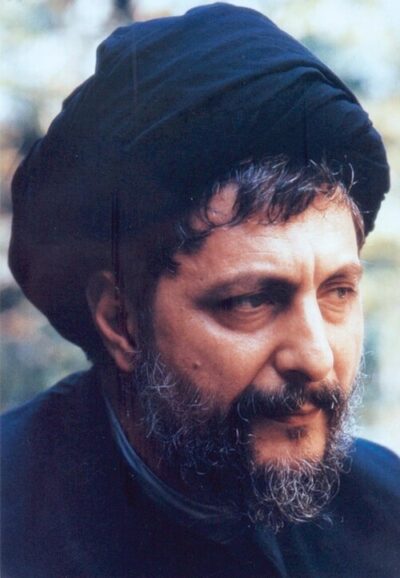
Al Sayed Musa al-Sadr
Al Sayed Musa al-Sadr was a Lebanese Shiite jurist and political activist. Born April 15, 1928, in Qom. Died 1978, in Tripoli. Positions held include grand ayatollah and Head of Amal Movement (1974–1978). Educated at University of Tehran and Najaf Seminary.
Facts
25 facts · 1 confirmed by two sources · 4 cited · 19 from one source · 1 where the sources disagree
What’s different
- Born: we show April 15, 1928 (Sources disagree). Wikidata also lists May 15, 1928
Where this comes from
Papalocal keeps its own record. It started from these sources; what each one said is kept here as it was copied, so a change on their side never changes this page by itself. Tap one to read its version.
What Wikidata says · copied November 16, 2026 · revision 2570040396
- Described as
- Lebanese Shiite jurist and political activist
- Other names
- Musa al-Sadr
- Born
- April 15, 1928 · 1 reference; May 15, 1928 · 1 reference
- Died
- 1978 · 1 reference
- Born in
- Qom · 2 references
- Died in
- Tripoli · 1 reference
- Citizen of
- Pahlavi Iran; Lebanon
- Occupation
- politician; theologian; imam · 1 reference; philosopher · 1 reference
- Positions held
- grand ayatollah; Head of Amal Movement (1974–1978)
- Political party
- Amal Movement
- Worked for
- Qom Hawza
- Education
- University of Tehran; Najaf Seminary
- Field
- philosophy
- Father
- Sadr al-Din al-Sadr
- Siblings
- Rabab al-Sadr
- Religion
- Islam; Shia Islam
- Lived in
- Qom; Tehran; Najaf; Tyre
- Wikipedias with a page
- 28
Wikidata item Q672145 (wikidata.org/wiki/Q672145), public domain (CC0). Copied November 16, 2026.
What Wikipedia says · copied November 16, 2026 · revision 1378261855
Musa Sadr al-Din al-Sadr (Arabic: موسى صدر الدین الصدر; Persian: موسی صدرالدین صدر; 4 June 1928 – disappeared 31 August 1978) was a Lebanese-Iranian Shia Muslim cleric, politician and revolutionary in Lebanon. He founded and revived many Lebanese Shia organisations, including schools, charities, and the Amal Movement.
Born in the Chaharmardan neighborhood in Qom, Iran, to an Iranian-Lebanese father and a Lebanese mother, he underwent both seminary and secular studies in Iran. He belongs to the Al-Sadr family from Jabal Amel in Lebanon, a branch of the Musawi family which traces its roots to Musa Ibn Jaafar, the seventh Shia Imam. Therefore, Musa al-Sadr is often styled with the honorific title Sayyid. He left Qom for Najaf to study theology and returned to Iran after the 1958 Iraqi coup d'état.
Some years later, al-Sadr went to Tyre, Lebanon as the emissary of Ayatollahs Borujerdi and Hakim. From Tyre, he published the periodical Maktabi Islam. Fouad Ajami called him a "towering figure in modern Shi'i political thought and praxis". He was noted to have given the Shia population of Lebanon "a sense of community". In 1974, al-Sadr co-founded the Amal Movement.
On 25 August 1978, Sadr and two companions, Sheikh Mohamad Yaacoub and Abbas Bader el-Dine, departed for Libya to meet with government officials at the invitation of Muammar Gaddafi. The three were last seen on 31 August. They were never heard from again. Many theories exist around the circumstances of al-Sadr's disappearance, none of which has been proven. His whereabouts remain unknown.
In September 2025, a BBC News investigative team reported that a body found in 2011 in a secret mortuary in Libya bore a strong resemblance to al-Sadr based on facial recognition analysis performed by Hassan Ugail at the University of Bradford. The BBC report presented testimonies claiming that al-Sadr was assassinated by the Gaddafi regime shortly after his arrival in Libya but this theory remains contested by al-Sadr's family and the Amal leadership.
- Born, in its opening lines
- June 4, 1928
- Died, in its opening lines
- August 31, 1978
From the Wikipedia article “Musa al-Sadr” (en.wikipedia.org/wiki/Musa_al-Sadr), by its contributors, under CC BY-SA 4.0 (creativecommons.org/licenses/by-sa/4.0/). Copied November 16, 2026; not changed.
Confirmed Two sources agree. Cited One source, and it names where it got it. One source One source, without a reference of its own. Sources disagree The sources disagree. We show the best-supported value and keep theirs below.
