
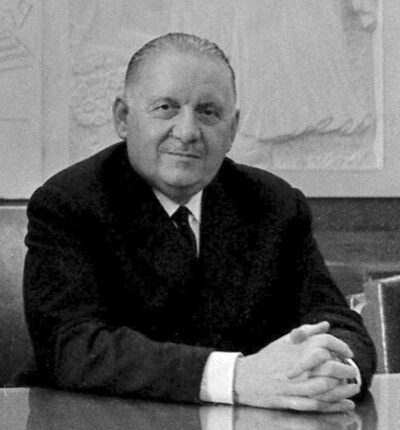
Alain Poher
Alain Poher was a French politician. Born April 17, 1909, in Ablon-sur-Seine. Died December 9, 1996, in Paris. Positions held include President of the European Parliament (1966–1969), Senator of the French Fifth Republic (1946–1948) and Member of the European Parliament. Educated at Mines ParisTech and Lycée Louis-le-Grand. Awards include Knight of the Legion of Honour, Croix de guerre 1939–1945 and Resistance Medal.
Facts
41 facts · 2 confirmed by two sources · 10 cited · 29 from one source
Where this comes from
Papalocal keeps its own record. It started from these sources; what each one said is kept here as it was copied, so a change on their side never changes this page by itself. Tap one to read its version.
What Wikidata says · copied November 16, 2026 · revision 2568213371
- Described as
- French politician (1909-1996)
- Other names
- Alain Émile Louis Marie Poher
- Born
- April 17, 1909 · 8 references
- Died
- December 9, 1996 · 9 references
- Born in
- Ablon-sur-Seine · 1 reference
- Died in
- Paris
- Citizen of
- France
- Occupation
- politician · 1 reference; French resistance fighter; statesperson · 1 reference
- Positions held
- President of the European Parliament (1966–1969); Senator of the French Fifth Republic (1946–1948) · 1 reference; Member of the European Parliament; President of the Senate of France (1968–1992); President of the French Republic (2 times) (1969–1974); Senator of the French Fourth Republic (1952–1995) · 1 reference; French co-prince of Andorra (2 times) (1969–1974)
- Political party
- Democratic Centre (1966–1976); Popular Republican Movement (1946–1966); Centre of Social Democrats (1976–1995); Union for French Democracy (1978–1996)
- Education
- Mines ParisTech; Lycée Louis-le-Grand; Lycée Saint-Louis; Paris Institute of Political Studies
- Awards
- Knight of the Legion of Honour (1950); Croix de guerre 1939–1945; Resistance Medal; Great Cross with Star and Sash of the Order of Merit of the Federal Republic of Germany; Ernst Reuter Medal (1988); Robert Schuman Medal (1986); Knight Grand Cross of the Order of Merit of the Italian Republic (1973); Grand Cross of the Order of Merit of the Republic of Poland (1991); Grand Officer of the Order of Merit of the Italian Republic (1968) · 1 reference; Grand Cross of the Order of Orange-Nassau · 1 reference; Grand Cross of the Order of the Oak Crown; Knight Grand Cross of the Order of Merit
- Field
- politics · 1 reference; legislative house · 1 reference; upper house · 1 reference
- Children
- Marie-Agnès Poher; Marie-Thérèse Poher
- Religion
- Catholic Church
- Wikipedias with a page
- 50
Wikidata item Q12950 (wikidata.org/wiki/Q12950), public domain (CC0). Copied November 16, 2026.
What Wikipedia says · copied November 16, 2026 · revision 1384879994
Alain Émile Louis Marie Poher (French: [alɛ̃ pɔɛʁ]; 17 April 1909 – 9 December 1996) was a French politician who served as president of the Senate from 1968 to 1992 and as acting president of France in 1969 and 1974. Poher was affiliated with the Popular Republican Movement (MRP) until 1966 and later with the Democratic Centre (CD) and Centre of Social Democrats (CSD), which he joined in 1976.
A native of Ablon-sur-Seine south of Paris, Poher was a longtime member of the Senate (1946–1948; 1952–1995), where he sat first for Seine-et-Oise until 1968 and then Val-de-Marne. He also served as president of the European Parliament from 1966 to 1969. As the longest-serving president of the Senate and the sole unelected president of the Fifth Republic, Poher remained an influential figure in 20th-century French politics. He ran in the 1969 presidential election but was defeated by Georges Pompidou in the second round.
Poher died at the age of 87 in 1996, a year after his retirement from the Senate.
- Born, in its opening lines
- April 17, 1909
- Died, in its opening lines
- December 9, 1996
From the Wikipedia article “Alain Poher” (en.wikipedia.org/wiki/Alain_Poher), by its contributors, under CC BY-SA 4.0 (creativecommons.org/licenses/by-sa/4.0/). Copied November 16, 2026; not changed.
Confirmed Two sources agree. Cited One source, and it names where it got it. One source One source, without a reference of its own. Sources disagree The sources disagree. We show the best-supported value and keep theirs below.
