
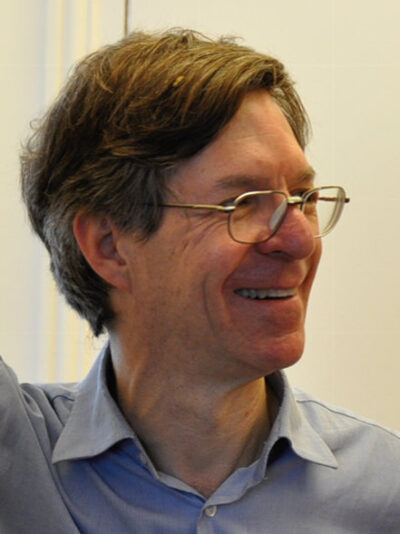
Alan Sokal is an American physicist and mathematician. Born January 24, 1955, in Boston. Known for Fashionable Nonsense. Educated at Harvard University and Princeton University.
Facts
16 facts · 1 confirmed by two sources · 3 cited · 12 from one source
Where this comes from
Papalocal keeps its own record. It started from these sources; what each one said is kept here as it was copied, so a change on their side never changes this page by itself. Tap one to read its version.
What Wikidata says · copied November 15, 2026 · revision 2555585155
- Described as
- American physicist and mathematician
- Other names
- Alan David Sokal, Alan D.Sokal, Alan D Sokal, Alan D. Sokal
- Born
- January 24, 1955
- Born in
- Boston
- Citizen of
- United States
- Occupation
- mathematician; physicist · 1 reference; university teacher
- Worked for
- New York University · 1 reference; University College London · 1 reference
- Education
- Harvard University; Princeton University; Harvard College
- Known for
- Fashionable Nonsense
- Field
- physics · 1 reference
- Father
- Nathan O. Sokal
- Religion
- atheism
- Website
- http://iris.ucl.ac.uk/iris/browse/profile?upi=ADSOK62
- Wikipedias with a page
- 33
Wikidata item Q370022 (wikidata.org/wiki/Q370022), public domain (CC0). Copied November 15, 2026.
What Wikipedia says · copied November 15, 2026 · revision 1381563357
Alan David Sokal ( SOH-kəl; born January 24, 1955) is an American professor of mathematics at University College London and professor emeritus of physics at New York University. He works with statistical mechanics and combinatorics.
Sokal is a critic of postmodernism, and caused the Sokal affair in 1996 when his deliberately nonsensical paper was published by Duke University Press's Social Text. He also co-authored a paper criticizing the critical positivity ratio concept in positive psychology.
- Born, in its opening lines
- January 24, 1955
From the Wikipedia article “Alan Sokal” (en.wikipedia.org/wiki/Alan_Sokal), by its contributors, under CC BY-SA 4.0 (creativecommons.org/licenses/by-sa/4.0/). Copied November 15, 2026; not changed.
Confirmed Two sources agree. Cited One source, and it names where it got it. One source One source, without a reference of its own. Sources disagree The sources disagree. We show the best-supported value and keep theirs below.
