
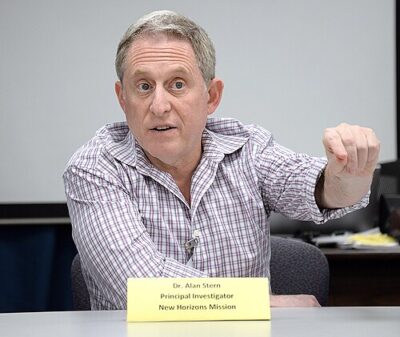
Alan Stern
Alan Stern is an American planetary scientist. Born November 22, 1957, in New Orleans. Positions held include NASA's Associate Administrator for the Science Mission Directorate (2007–2008). Educated at St. Mark's School of Texas and University of Texas at Austin (3 times). Awards include Nature's 10, Fellow of the American Geophysical Union and Fellow of the American Association for the Advancement of Science.
Facts
23 facts · 1 confirmed by two sources · 10 cited · 12 from one source
Where this comes from
Papalocal keeps its own record. It started from these sources; what each one said is kept here as it was copied, so a change on their side never changes this page by itself. Tap one to read its version.
What Wikidata says · copied November 18, 2026 · revision 2515776241
- Described as
- American planetary scientist
- Other names
- Sol Alan Stern, S. Alan Stern, Dr. Alan Stern, S A Stern
- Born
- November 22, 1957 · 2 references
- Born in
- New Orleans · 1 reference
- Citizen of
- United States
- Occupation
- astronomer; engineer · 1 reference; researcher; astrophysicist · 1 reference
- Positions held
- NASA's Associate Administrator for the Science Mission Directorate (2007–2008) · 2 references
- Worked for
- Southwest Research Institute (1991–) · 2 references; National Aeronautics and Space Administration (2007–2008)
- Education
- St. Mark's School of Texas (–1975) · 1 reference; University of Texas at Austin (3 times) (1978, 1980, 1981) · 1 reference; University of Colorado Boulder (1989) · 1 reference
- Member of
- International Astronomical Union · 1 reference
- Awards
- Nature's 10 (2015) · 1 reference; Fellow of the American Geophysical Union (2021) · 2 references; Fellow of the American Association for the Advancement of Science (2007) · 1 reference; Fellow of the American Institute of Aeronautics and Astronautics · 1 reference
- Field
- astrophysics; planetary science; aerospace engineering
- Lived in
- Niwot (2019) · 1 reference
- Website
- https://alanstern.space/
- Wikipedias with a page
- 18
Wikidata item Q2331659 (wikidata.org/wiki/Q2331659), public domain (CC0). Copied November 18, 2026.
What Wikipedia says · copied November 18, 2026 · revision 1385986741
Sol Alan Stern (born November 22, 1957) is an American engineer, planetary scientist and private astronaut. He is the principal investigator of the New Horizons mission to Pluto and the Chief Scientist at Moon Express.
Stern has been involved in 24 suborbital, orbital, and planetary space missions, including eight for which he was the mission principal investigator. One of his projects was the Southwest Ultraviolet Imaging System, an instrument which flew on two space shuttle missions, STS-85 in 1997 and STS-93 in 1999.
Stern has also developed eight scientific instruments for planetary and near-space research missions and has been a guest observer on numerous NASA satellite observatories, including the International Ultraviolet Explorer, the Hubble Space Telescope, the International Infrared Observer and the Extreme Ultraviolet Observer. Stern was executive director of the Southwest Research Institute's Space Science and Engineering Division until becoming Associate Administrator of NASA's Science Mission Directorate in 2007. He resigned from that position after nearly a year.
His research has focused on studies of our solar system's Kuiper belt and Oort cloud, comets, the satellites of the outer planets, Pluto, and the search for evidence of planetary systems around other stars. He has also worked on spacecraft rendezvous theory, terrestrial polar mesospheric clouds, galactic astrophysics, and studies of tenuous satellite atmospheres, including the atmosphere of the Moon.
- Born, in its opening lines
- November 22, 1957
From the Wikipedia article “Alan Stern” (en.wikipedia.org/wiki/Alan_Stern), by its contributors, under CC BY-SA 4.0 (creativecommons.org/licenses/by-sa/4.0/). Copied November 18, 2026; not changed.
Confirmed Two sources agree. Cited One source, and it names where it got it. One source One source, without a reference of its own. Sources disagree The sources disagree. We show the best-supported value and keep theirs below.
